Be Flexible on the Details.

There’s an excellent profile of Jeff Bezos and Amazon in this week’s New Yorker, by Charles Duhigg, and the whole thing is worth reading. One paragraph in particular stood out to me:

Most firms have a mission statement that even the C.E.O. has trouble remembering. Amazon employees, Freed discovered, studied the Leadership Principles like Talmudic texts. During his first few years, he occasionally pulled colleagues, and even Bezos, aside to ask questions. What, for example, does “leaders are right a lot” really mean? Bezos explained, “If you have a really good idea, stick to it, but be flexible on how you get there. Be stubborn on your vision but flexible on the details.” Executives at other companies tended to lay out definitive plans. But Bezos urged his people to be adaptable. “People who are right a lot change their mind,” he once said. “They have the same data set that they had at the beginning, but they wake up, and they re-analyze things all the time, and they come to a new conclusion, and then they change their mind.”

Being stubborn on the vision but flexible on the details is such a good way to approach work at an office. The big picture matters — have a sense of where you want to go, and what you want to deliver. But those little details? The tools you use, the timeline for a project, all of the minutiae — those can always change. Don’t get tied up by the little things. Be flexible, and let your team drive the details.

———

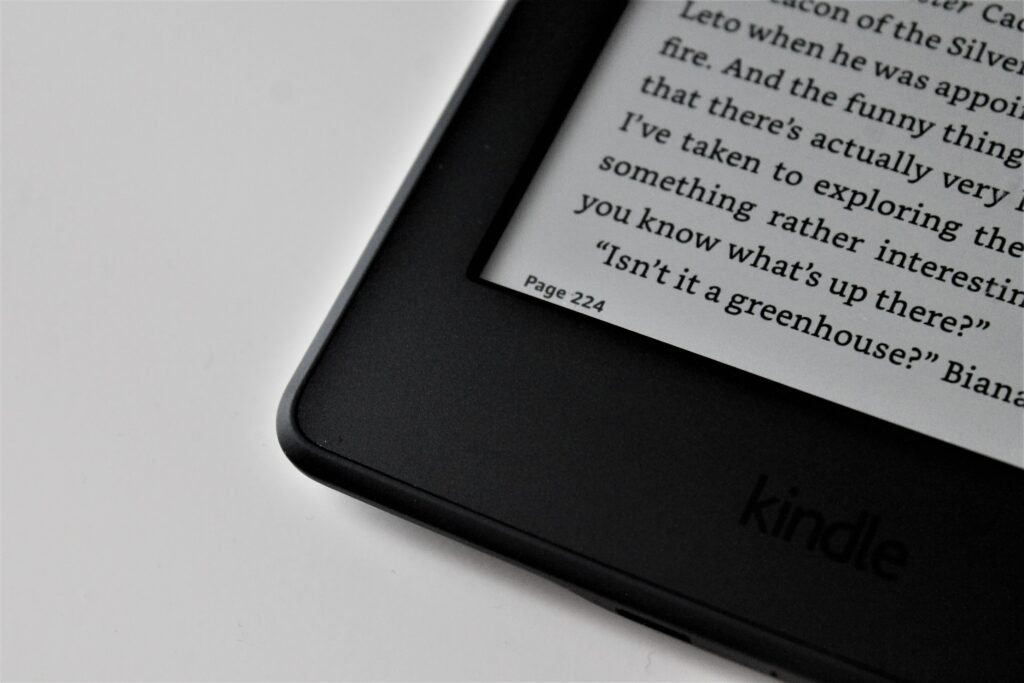
That’s a photo of an Amazon Kindle at top. It was taken by Amanda Jones for Unsplash.

Here, Read This: “Draw the Owl.”

I love this post from Daniel Zarick, a former product manager at Twilio, about the strategy at his old company. The focus was always on starting quickly and figuring things out as you go. Or as they put it: “Draw the owl.”

Start figuring it out. Put some of the pieces together. When you truly get stuck, ask for pointed advice. Stuff like “What sort of salary should I be asking for at my experience for this type of job?” and “Do you think X marketing strategy is good for this type of product?”

Nobody else can lay out all the steps for you, because nobody else has been you or is in your situation.

You’ve just got to draw the owl.

Read the whole post here.

Less is Enough.

You’ve heard the expression, “Less is more.” I don’t believe that to be true.

I think less is enough.

I believe that, yes, you should sketch out those big plans. You should think about the best-case scenario. You should lay out the roadmap — the work you want to do in six months, in twelve months, and beyond.

But you should also be willing to start soon. Remember: Direction is more important than speed. The goals you want to achieve are ambitious, and they’re going to take time. You’re not going to be able to move as fast as you want to go.

But you can start. It won’t be everything you want, but take the first step anyway. Start moving in the right direction.

Less isn’t everything you want — but it’s enough to start.

———

That photo by Jamie Templeton was published on Unsplash.

Make Time for the Work.

When you become a boss or a manager, you have to learn how to deal with meeting creep — that phenomenon when meetings take over your calendar, with barely enough time to take a breath between them. You’ve got check-ins and calls and workshops and presentations. Every hour between 9 and 5 is booked.

And the question becomes: When do you actually do the work?

There are a few strategies I’ve tried over the years that have helped lessen the burden of meetings on my calendar:

1) Make your meetings better — Make sure everyone has an agenda for the meeting up front. When the meeting starts, recap the topics that need to be discussed, and see if anyone has anything else they need to discuss. Close the meeting with clear next steps. And by all means, try to finish on time!

2) Turn some meetings into drop-bys or emails — There are a number of meetings that could be solved by taking 5-10 minutes to drop by a coworker’s desk to talk things out. And there are far too many meetings that could have been a quick question solved over email. Know when you need to call a meeting (to build consensus, to decide on next steps as a team, to check in with a team member, etc.) and when you can save time.

3) Make time on your calendar for actual work — That might mean blocking out 90 minutes a few times a week on your calendar to sit down and do real work. It’s tough to get anything done when you’re only getting five minutes between meetings to try to take on a project. If your day’s overrun with meetings, block some time off so that others can’t take over your entire calendar.

Another idea: Save certain types of meetings — 1-on-1s, for instance — for certain days of the week. So many employees take days off on Mondays and Fridays throughout the year — meaning that any Monday/Friday check-ins end up getting frequently rescheduled — that maybe you want to move all of your 1-on-1s for mid-week, and save Monday and Friday for full work days.

———

That photo of an office building comes via Dylan Nolte for Unsplash.

Don’t Overthink It.

This morning, I had an idea for a friend, but I wasn’t sure how to tell them. I started thinking about how I’d present the idea to them. In my head, I started writing the email to them — how I’d say hi, maybe share a story or two from the weekend, then get into the idea, couch the idea with a few different caveats just in case they didn’t like it, and then close with a “lemme know!” kind of thing at the end. I spent the better part of breakfast thinking about that email, writing and rewriting it in my head.

I can overthink things sometimes, and this was one case. It was a simple idea, not all that controversial. It didn’t need a whole email. In fact, I realized, it didn’t need an email at all — a text would do the trick.

So that got me out of the rut. I picked up my phone, and fired off the text. Two sentences, and it was done. If my friend wants to follow up, they can. If they want to talk about it on the phone, they can. But I spent 20 minutes this morning overthinking an email I didn’t even send, and then 20 seconds sending a text instead. I wish I could have those other 19 minutes and 40 seconds back.

Send the email, send the text, make the decision — and move on. You’re too busy to waste time overthinking something as small as this.

———

When you search “overthinkingon Unsplash, that photo by Nathan Dumlao pops up.

The Power of a Warm Welcome.

Inbox Collective’s been going for a few weeks now, and I’m working with several different clients. But those clients are coming from an unusual source — not, as many suspect, from cold calling, networking, or even SEO.

They’re coming because of my Google Doc — and more specifically, because of my welcome email.

Back in January, I launched Not a Newsletter, the Google Doc where I share advice about sending better email. With it, I also created an email alert for readers to find out when the next edition would go live. A little while later, I migrated everything over from TinyLetter to Campaign Monitor so I could set up an automated welcome series. Every reader who signs up for my newsletter now gets this message in their inbox:

The next edition of Not a Newsletter won’t be out until next month. But in the meantime, I want to know more about you. I actually mean that: I want to know who you are, and why you’re so interested in sending better emails!

Hit reply to this email (I’m at dan@inboxcollective.com), and tell me:

1.) Do you have a personal newsletter, or work on newsletters as part of your job?

2.) What’s the biggest challenge you’re facing with your newsletter(s)?

Let me know, and I’ll do my best to make Not a Newsletter the best resource it can be for you.

The secret of the email world is that welcome emails open at incredibly high rates — often multiple times higher than a normal email. (77% of readers open my welcome email.) And when you get a chance like that to make a first impression, you better take it. If the inbox is a living room, the welcome series is a host inviting you in, taking your coat, and getting you comfortable in your new surroundings.

So with my welcome series, I’m getting right to the point: By asking readers to reply to the newsletter to tell me what they’re struggling with, I’m starting a conversation about their email needs. (I’m not selling them anything or pitching them on Inbox Collective — just asking a question to get the conversation going!) I reply to every single one of these emails. (Even if I can’t do much to help, it never hurts to offer someone a friendly hello.) Sometimes, I can help them right away — with a link or a tip to push them in the right direction. Sometimes, I can hop on the call to talk about the issue in greater detail. And in a few cases, those conversations can actual lead to work for Inbox Collective.

Soon, I’ll go further with the welcome series: Adding additional emails detailing resources readers can use, and next steps on how they can work with me. The welcome series is an opportunity — and it’s one that anyone who works in email should be taking advantage of.

———

That welcome mat photo comes via Jon Tyson and Unsplash.

Here, Read This: “Gone in 3.9 seconds.”

I got the question for the hundredth time the other day: Why would you leave The New Yorker now?

And what I keep saying: Right now, I have an opportunity to help a larger community — news organizations, non-profits, brands — with email. The moment exists right now for me to help, and I don’t know how long this moment will last. So if I want to help, I need to do it right now.

I was thinking of that while reading the story of JamesOn Curry, a former basketball player whose NBA career lasted all of 3.9 seconds. He was a high school star, a college star, and dominated the NBA’s minor leagues, but his actual NBA career never took off. His is a Moonlight Graham story — the athlete who made it the big leagues, but never got more than that one chance. It’s a reminder: Enjoy the moment. You never know when that might be the only one.

Read Curry’s story, “Gone in 3.9 seconds,” here on ESPN.com.

Give Yourself Time.

Today is my last day at The New Yorker — and tomorrow, Sally and I will get on a plane, go to a beach, and do a whole lot of nothing for a few days.

If you’re switching jobs, that time off between work is invaluable. Once you get into the new job, those first few months will be intense. You’ll be meeting people, getting up to speed, and going through the montage scene. It’s going to be a lot — and if you don’t give yourself time to recharge, you might burn out.

So do yourself a favor: If you’re leaving for a new job, ask your new boss for time off — two weeks, minimum. (They’ll want you to start right away. Don’t be afraid to push back.) Give yourself the freedom to go travel somewhere nice for a few days — the kind of vacation you might not get to take once your new job starts. Get away from email, get away from work, and just enjoy yourself. Give yourself the time to read, to travel, to relax, to do as little as you please. Don’t hop into the next thing until you’ve taken that time for you.

———

That photo was taken the last time I took some time off and went to the beach for a whole lot of nothing.

I Worked for Two Years at The New Yorker. This Is What I Believe.

Every year, around Thanksgiving, I write a blog post that I call The Things I Believe. It’s an inventory of the year that was, as I look back on what I’ve learned and the person I am at that moment.

As as I approach my final day at The New Yorker — in September, I start full-time on Inbox Collective — I wanted to look back at two years in this newsroom. It’s been an incredible place to work, and I feel so lucky to have been a part of this team. So as I look back on my time at The New Yorker, this is what I believe:

Whatever it is you do, be the best at it — Whenever someone asks me how to get a job at The New Yorker, I always tell them: This is a place full of the best people in their field. I truly believe we have the best editors, writers, fact checkers, and artists anywhere. My colleagues are so unbelievably good at what they do — I continue to be amazed at how talented this team is. And if your ambition is to work at The New Yorker one day, keep working to be the best in your field. When you are, this place might be ready for you.

Give yourself time to focus — It’s not just that the people who work at The New Yorker are talented. It’s that they’re given the opportunity to focus on their work. It’s not uncommon to hear that a copy editor or a fact checker is going to be working on a particular piece for a few days — or longer — to make sure that the work is done right. Focus breeds excellence.

Make the extra phone call — Before The New Yorker, I’d never worked at an organization that had a dedicated fact-checking team. Our fact checkers check everything — and I do mean everything — that can be checked. Here’s a glimpse into the process, as explained through the experience of actor Daniel Radcliffe, who was once tasked with fact checking a review of a Mexican restaurant. Their attention to detail is remarkable.

Don’t take yourself too seriously — Here’s another secret of The New Yorker: If we just published lengthy profiles about Polish novelists or reported pieces about the future of modern dance, I’m not sure we’d get that many readers. What sets The New Yorker apart is the humor. This is a place that can be silly, goofy, and subversive, and that makes all the difference.

It’s been a joy being a part of this team. I’ll always be a reader — and a fan.

———

That New Yorker cover comes via the excellent @NewYorkerArt Instagram.

When Will Then Be Now?

This is the second in a semi-occasional series of Spaceballs-inspired blog posts.

Lord Dark Helmet: What the hell am I looking at? When does this happen in the movie?
Col. Sandurz: Now. You’re looking at now, sir. Everything that happens now is happening now.
Lord Dark Helmet: What happened to then?
Col. Sandurz: We passed it.
Lord Dark Helmet: When?
Col. Sandurz: Just now. We’re in now now.
Lord Dark Helmet: Go back to then!
Col. Sandurz: When?
Lord Dark Helmet: Now!
Col. Sandurz: Now?
Lord Dark Helmet: Now!
Col. Sandurz: I can’t!
Lord Dark Helmet: Why?
Col. Sandurz: We missed it!
Lord Dark Helmet: When?
Col. Sandurz: Just now!
Lord Dark Helmet: When will then be now?
Col. Sandurz: Soon.

When you’re building something new, it’s hard to be patient. You’ve got a great idea, and you’ve got some momentum, and it feels like you’ve got all the potential in the world. You want to fast forward to the ending — when the work is done, and everyone gets to see your genius idea become something real.

But when it comes to the work, there is no fast-forward button. There are no shortcuts. The work still needs to be done. Networks still need to be built. The team needs to be assembled. Hours need to be put in.

The future you want needs to be made, piece by piece, and day by day. I promise: Then will be now — and sooner then you think. But you’re in now, now. It’s time to start putting in the work.

———

That photo and quote at top comes from Mel Brooks’s classic spoof, Spaceballs.