What Would You Say You Do Here?

“Life. It’s the stories you tell.” — Eric Garland

 
There’s a thing that any entrepreneur needs to learn how to do in his/her career — if he/she wants to be a successful entrepreneur, that is.

Make the pitch.

You’re at a conference. You’re at an event. You find yourself seated next to Bill Gates on an airplane.

You’ve been working on something. Maybe it’s a business. Maybe it’s your career.

You have a really short window of time to make an impression, because here comes a big question:

“What would you say you do here?”

This is where you need to avoid your instincts. This isn’t the time to dish out a job title. You’re not talking to HR. You’ve got Bill Gates next to you!

You’ve been given a tiny window to wow him with your story.

But this situation isn’t just limited to people pitching a company or a product. Every single person needs to figure out their story — and how to pitch it.

So what’s your story? It’s a combination of your work and your passion. We need a little taste of what it is you make/build/do and a lot of why you do it. Your story is the thing that tells us why you’re great, and why we need to pay attention.

Take Sam Jones of Formation Media. Here’s his story:

I’ve met Sam several times and each time I’ve been at an event with him I’ve heard his opening line, “My name is Sam Jones. I buy dead magazines.” He gets a stare every time. You can’t help but lean forward and want to hear what the next line is. He’s a master. He waits for a brief moment and lets the suspense build. He knows your next line in advance, “Excuse me? You do what?”

And once he’s hooked you, he gets into the story, explaining how he does what he does and who he works with.

When I work with young reporters, I ask them how they’re pitching themselves for jobs. There are thousands of young reporters out there applying to the same small pool of jobs. To get one, you’ve got to stand out.

I encourage reporters to pitch themselves differently. Let everyone else send the standard cover letter. Instead, tell me: What do you do?

I build great communities around stories.

I use data to tell great stories.

I listen, I learn — and then I share with my readers.

Something like that can stand out. And when you brand it across your platforms — on your blog, your Twitter bio, your resume — it really drives the point home.

What you’ll learn is that it’s surprisingly easy to stand out. The masses are all doing the same thing. Even taking a few steps out of the mainstream will get you noticed.

Then it’s just a matter of doing the work to establish yourself as someone truly different.

If you get on that plane with Bill Gates, here’s all I ask: Don’t tell him your job title. Tell him what you’re working on. Tell him why you’re passionate about it.

Tell him a great story.

It won’t be hard to do. After all, it’s your story.

Success Is….

“Success is never owned, it’s only rented; and whether you win or lose, the rent is still due every day.” — Rory Vaden

 
Success isn’t an easy thing to define. It is — at best — elusive. You set a goal, and then when you get there, you find that the goalposts have moved. Your definition of it has changed.

Still, I’m finding on a day-to-day basis that there are ways to measure success — and they’re not quite what you might expect.

Success is…

Taking the first step.

…Getting to unexpected places and knowing how to find your way out.

…That smile when you mention what you do.

…Surprising yourself with answers you didn’t know you knew and lessons you didn’t realize you’d learned.

…Being willing to do work every day.

Finding your focus.

Defining your greatness.

…A to-do list that’s been finished off and loaded up again for the next day.

…Loving something and giving everything to it.

…Staying in over your head without fear of eventually going under.

Finishing what you start.

Most of all, success is often unexpected — even when you’ve been chasing it all along.

That gold medal at the top comes via @johnphotography.

How Long Are You Willing To Suck?

The Exorcist Stairs

Put yourself out there and give yourself permission to suck. That’s not to say you should try to suck, but you have to give yourself permission to allow for the possibility of sucking. Without sucking, you’re never going to find your boundaries, and you’ll never push through those boundaries. That’s all it is. — Michael Ian Black

———

You aren’t going to like this blog post. I can tell you that already. I think the message in here is ultimately uplifting, but I’m guessing you’re not going to see it that way.

Here goes anyway:

If you want to do anything good in this world, you are going to have to suck at it for a very long time.

If you want to be a great stand-up comic, you’re going to have to get on stage a lot and bomb. If you want to be a great guitarist, you are going to have to spend a long time struggling with basic chords. If you want to be a great writer or a great businessman or a great athlete, you’re going to have to deal with one simple truth:

Before you can get any good, you have to suck. Unless you’re a born genius, this is just how it works.

First you start. Then you struggle. Then you struggle some more.

And then, maybe waaaaaaay down the road, if you’re able to accept the sucking and push through, you might get to a point where you actually get kinda good.

And then you’re going to suck some more, and some more.

And some more.

And then maybe, somewhere even further down the road: Success! Breakthroughs! Money! [1. I can’t guarantee that last part, actually. Sorry.]

I promise you that if you have the right ingredients in place — passion, hustle, skills, time and a strong tribe — hard work will lead you somewhere great.

But first, you’re going to go through a lot of this:

That very scene has happened to anyone who’s tried to do anything great. Doubt happens. Fear happens. Struggle happens.

To all of us.

I just got finished with “American on Purpose,” Craig Ferguson’s autobiography. Craig’s a guy who’s made it — he has his own TV talk show, and he’s done stand-up for the President of the United States. He’s doing alright for himself.

But when you read his autobiography, the first 70 percent of the book is all about how much things sucked for him in the first 15 years of his career. He joined bands, and they sucked. He started in stand-up with a character called Bing Hitler — Bing Freaking Hitler! — and you can imagine how much that sucked at the start. He had audience members actually fight him on stage during his stand-up routine. That’s how much they hated him when he started.

For a two week stretch in Edinburgh, he slept in phone booths at the train station. He sucked so much on stage, he couldn’t afford a hotel room on the road.

He kept going. He got some good breaks. He caught a lot of bad ones. He just kept pushing on.

Today, after a lot of sucking, he has his own TV show — and even when he started that, critics told him that he’d suck at it.

Face it: Doing great work isn’t easy. It takes time. It takes persistence. It takes stubbornness.

But maybe above all, it takes a certain faith in the journey, and it takes an ability to bounce back from many, many tiny failures.

Promise yourself that you’ll keep going. Don’t let the first or the 50th or the 500th failure stop you. The longer you’re willing to suck, the wider the window you give yourself to do something great.

Greatness is out there for all of us — as long as we keep on pushing through.

Those photos of the stairs from ‘The Exorcist’ were taken by Matthew Straubmuller.

An Oshinsky Family Lesson: Do Big Things With Crazy Amounts of Love.

“Of all the things to be picky about, people is the most important.” — Nick Seguin

 
Two years ago, I wrote a happy birthday message to my mother on this blog. It read:

“A very happy birthday to you, mom, without whom this blog would not be possible, and without whom I would be rendered hopelessly, painfully normal.”

Normal.

Normal.

Normal.

I shudder just thinking about it.

Normal isn’t something we Oshinskys do, and it gets us some weird looks. I’ve done a lot of things that I keep being told I’m not supposed to have done. For me, lots of stuff has come out of order. I covered my first NFL game before I went on my first real date. My first paid job in newspapers wasn’t a full-time gig, but it did involve covering the Olympics in Beijing.

This thing I hear from others — that there is some sort of order to this life — has never really applied to me, and I don’t mind that at all.

Mine is my path, and I’m rather fond of where it’s been taking me, potholes and steep climbs and all.

I learned the ways of the unmarked path from my family. The Oshinsky family does not do ordinary.

My father, at 55, decided he wanted to get into the best shape of his life, and he spent a year doing just that.

My mother, at 52, decided she wanted to run a marathon, and she finished at a 14:30-per-mile pace.

My sister decided she wanted to spend a semester of high school studying abroad — and then pulled off five months on the beaches of the Bahamas.

My brother decided he wanted to use his bar mitzvah for good, and raised $15,000 to build a playground in post-Katrina New Orleans.

I do not believe that we are an extraordinary family. We are not the smartest people you will ever meet, and we are certainly not the most athletic.

But in the Oshinsky family, we take pride in our work. We do big things with great amounts of love. We hustle.

When we go for something, we go all in.

I cannot imagine life any other way.

That photo at top is of my little sister, Ellen. She does crazy beach workouts.

You Will Screw Up Over And Over Again. (And That’s Okay.)

“I would not change a thing because if I did, I wouldn’t be me and I’m really glad to be me. There are a hundred things I regret; there are 75 things I could do over, but I wouldn’t because that would mess up what I ended up with.” — Seth Godin

 
Endings tend to bring about this sense of nostalgia in me. Four years ago this month, I was finishing up my stint covering the Olympics from Beijing. Two years ago this month, I was midway through my summer in Biloxi.

I look back now on these versions of me — four years ago, two years ago — and I laugh.

Who was I? What the hell was I doing?

And I wonder, as Stry.us’s work in Springfield comes to a close this month: Will I look back two years from now on Springfield and wonder the same thing?

I’m guessing I will.

Time isn’t good for much, but it’s wonderful for giving you perspective. It’s hard to know in the moment what’s happened. With time, truth reveals itself.

I was talking to a former boss of mine yesterday, and we were laughing about all the stuff I screwed up at my old job. I was just out of college, and I was pretty raw. She watched as I messed things up over and over again. I confessed over the phone that looking back, I’m not really sure how she put up with me.

I was hugely ambitious, and maybe even a tiny bit talented, but I was also largely unaware of what was really going on in the office. This wasn’t the “no rules” world of start-ups. This was a newsroom, where actions have consequences.

I’m lucky to have had bosses who saw me as talented — and not as pure trouble. If you’re as lucky as I am, you’ll also work with people who believe in you and give you chances to try and try again.

Do I wish I could go back and keep myself from all that trouble? Certainly.

But I can’t. I can’t stop what’s already been done.

Besides, all of those mistakes, all of those screw-ups — they led me to here.

What’s done is done. But there are things I’ve learned you can do. You can take ownership of your mistakes. You can hold yourself responsible for what’s been done. You can take stock of what’s happened — and you can show others how you’ve grown.

Most of all, you can ask for help. For forgiveness. For an opportunity to prove yourself again.

This is a life of many, many little opportunities. You work hard for them. You will screw many of them up anyway. I certainly have.

But one or two will come along, and you’ll find the courage to make something awesome with them. You’ll find a way to define your greatness and then make it so.

So let the past be the past. Don’t hide from it, don’t run from it. And don’t let it stop you from what’s next.

Remember: We learn from the past. We make things happen in the present.

Onward we go.

That lovely photo of the road ahead comes via @stienz.

Finish What You Start.

I finished a sprint tri in Republic, MO.

Back in May, I started looking for a race. I knew that with Stry.us happening, I had plenty of business goals for the summer. What I didn’t have was an athletic goal to work toward.

So I started looking for a race. The 5Ks all seemed to fall on weekends when I’d be traveling for business. There were a few half marathons or marathons around the Ozarks, but there was no way I was doing one of those.

Then I found one that could work: The Republic Tiger Tri, taking place just around the block from Stry.us HQ. The race seemed straightforward: 300 yard swim, 12 mile bike, 5K run.

I signed up before I had a chance to convince myself that it was too crazy to do.

I spent the summer training. I did lots of running, lots of biking, and a weekly swim at the Republic pool. I did stuff I’d never done before: Kickboxing, intense weightlifting. Starting in July, I cut out beer and most sweets.

On Friday, when I picked up my race packet, I’ll admit that I was a little scared. Then I drove the bike course.

And I was a lot scared. Who knew the Ozarks had hills like these?

But I kept telling myself: You finish what you start, Dan. You signed up for a sprint triathlon. You thought this was gonna be easy?

I woke up at 5 on Saturday morning. I had everything packed in advance. I drove up to the race course. I got everything laid out in the transition area. The PA announcer called everyone to the pool.

And then I looked at my stuff, and I realized I was missing something:

A bike helmet.

There were 400 people competing in this thing, and I was the only one dumb enough to forget a bike helmet.

But I didn’t panic. Hell, I’m the guy who’s written a blog series called “The Things I Think About When Every Fucking Thing Goes Wrong.” I called Sarah, one of my reporters. I talked to the volunteer in the parking lot and one of the volunteers at the finish line. We coordinated a plan. Sarah would bring the bike helmet up to the course, and the volunteers would get it to my bike. It would be there waiting for me when I got out of the water.

Problem solved.

I grabbed my goggles and started to run up to the pool. They’d be putting in swimmers one at a time, and I’d be in the middle of the pack. I had a bit of time before I started the swim.

And then my goggles exploded.

Maybe exploded isn’t the right word. Disintegrated might be more appropriate.

I was running up to the pool, holding my goggles in my right hand, and the strap just snapped.

I was left holding the lenses and nothing else.

Oh, hell.

But that’s alright, I told myself. You finish what you start. And I’m the guy who believes that the harder the journey, the better the reward.

I found a volunteer, and she found the head lifeguard at the pool. I just need something functional to swim in, I told him. I’ll swim in a snorkel mask if I have to.

He did me one better: He found an extra pair of goggles from another lifeguard.

Second problem solved.

I got myself in line, right in the middle of a group that expected to swim the 300 yards in 6:30. I started talking to the guy in front of me. He was telling me about how he’d run a marathon last year in Fayetteville, Ark. — at an 8:20 pace!

I was blown away. I wish I could run like that, I told him. Of course, I said, you’re a bit lighter than me.

He weighed about 140 pounds.

That’s not quite true, he told me. Two years ago this month, he weighed 255 pounds. He went to the fair in Springfield with his daughter, and the fair wouldn’t let him on the rides. He was too fat.

He’d had enough, he said.

So one step at a time, one day at a time, he started working it off. He gave himself big goals. Hit 200 and he’d buy a pickup truck. Go lower and he’d try a big race.

He’s now the owner of a new truck. He’s run a marathon. They let him on the rides at the fair. He doesn’t have to worry about being the “fat dad” at school anymore.

Suddenly, listening to his story, all the chaos of my morning got a lot less complicated. His story put everything in perspective for me.

He’d had to change his life to get here. I’d put in the work this summer — but nothing quite like that.

I had no excuses. I just had to finish what I’d started four months earlier.

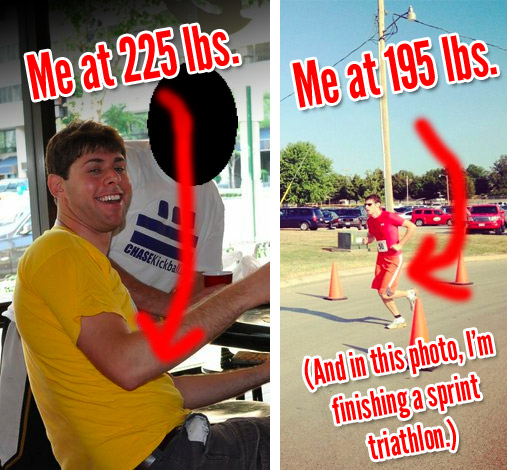
I finished my sprint tri on Saturday in 1:26:56 — and I brought it home with a 27:10 5K. I nailed the swim. I conquered the bike, and all those hills I was terrified of the day before.

And when I hit that run, everything hurt. I started feeling muscles in my legs that I didn’t know I had.

For the run, I turned to one final source of inspiration. I thought about what my sister had told me on Friday. She’s run a couple of half marathons. She’s one of the toughest people I know.

A race like this is 90 percent mental, she’d told me. Just keep putting one foot in front of the other. Eventually, all those little steps will take you somewhere.

So I took her advice. I pushed hard through the run. I kept my head up and my feet moving.

And damn if it didn’t feel good when I crossed that finish line and had the race official hand me my time. Damn if it didn’t feel good to see Sarah running up to give me a giant hug, her yelling out, “I can’t believe you just did that! I can’t believe you just did that!”

Damn if it doesn’t feel good to be able to say now: I finished what I started.

Welcome to danoshinsky.com 2.0.

“People respect perfection, but they fall in love with imperfection.” — Derek Shanahan

 
I started this blog four years ago. The first post was a photo gallery. Since, blog posts have been a little all over the place.

But starting in January, this blog got focused. It’s no coincidence that as I got focused with Stry.us, the blog took on a similar state of zen.

This year, I’ve finally found the groove for danoshinsky.com. This is a blog about doing great work, hustling, and making things happen.

Behind all of this is a promise from me to you — a promise to share lessons about doing great work.

So that’s why I decided to update the name of the name of the blog. You’ll still find this blog at danoshinsky.com. But it’s now called “Good. Better. Done.” [1. I was inspired by blogs by Chris Guillebeau and Alexis Grant, who’ve done a similar things with their blogs.] The name comes from a post I wrote in April, one of my favorites here on the blog.

“Good. Better. Done.” is only the start of what will be a big revamping of this site over the coming months. I’m really excited to unveil what’s next, and to start building a stronger community around great work.

Thanks for reading, and welcome to the new site. Let’s do great work this week.

Photo at top via @lovagebuzzage.

Learning To Solve For X.

“Impossible is only true until you prove it otherwise.” — Tanner Christensen

 
There’s this thing I tell people often, whenever the bill comes or whenever a series of numbers get laid out on the table.

“I’m not very good at math,” I’ll say.

This is a standard journalism line. Journalists all say they’re bad at math. [1. This is probably a bad sign for an industry that’s starting to focus more and more on the bottom line.]

But I wasn’t always lousy at math. Actually, I’ll confess that I used to like it.

I remember when math made sense to me. Algebra was a wonderfully simple thing: Look at an equation, locate the parts, break them down and then just solve for x.

Simple.

There were nuances, sure, and tricks to help you get there faster. But ultimately, finding that “x” was all that mattered.

I look back now and realize that my worldview was inadvertently shaped by forces like algebra. It taught me to be a problem solver.

As a kid, I never dreamed of changing the world. I never wanted to be an astronaut or a firefighter or the President. I can’t remember any major ambition or goal from my childhood, really.

Mostly, I wanted to do my schoolwork well, and score a couple of goals at soccer games, and wake up early enough on Saturday mornings for cartoons.

Modest goals, all.

Every day started by sorting out the variables and finding “x” in my daily life. “X” meant learning how to the work I needed to do to get the grades I wanted. “X” meant finding new ways to score on the field. “X” meant discovering that I could leave my blinds open on Friday night so the light would quietly wake me on Saturday morning and I could tip-toe downstairs to watch TV.

In my little corner of the universe, I wasn’t focused on changing the world. I was all about making little things happen — locating “x,” and then solving for it.

The “x” has gotten more difficult to find over the years. The challenges have gotten bigger. The variables have gotten more complicated. I feel so lucky to have these challenges in my life.

But the bigger the problem, the smaller the steps that need to be taken to solve for “x.” There are no big breakthroughs or magic bullets, I’ve found, just thousands of small steps.

It never hurts to have big goals. But the only way to achieve them is through doing small things, through solving for “x” over and over again — until all those little answers add up to the breakthrough you wanted all along.

Photo at top via @iheartstana.

The First Step To Greatness Is Defining It.

An empty Hammons Field

“Whatever you can do, or dream you can do, begin it. Boldness has genius, power, and magic in it. Begin it now.” — William Hutchinson Murray

There’s a moment you’ve probably never seen at a stadium. It’s about 30 minutes after the game ends. The fans are already on their way home. The ushers are cleaning up the aisles. The grounds crew is on the field. The lights are still on.

And there’s this strange quiet in the stadium. There’s no music playing, no athletes on the field.

What you’re left with is a big, empty stadium, just waiting for someone to come on in and do something amazing.

It’s impossible to look at an empty stadium — for me, at least — and not think about all the great things that are yet to come in such a place. When I look at a stadium, I see an incredible stage on which greatness can and will soon exist.

For many of us, such greatness is elusive. It’s within all of us, but it can’t just be unleashed on the world. Greatness, like anything else, needs to be focused.

Here’s the thing with greatness: First you have to define it, and only after you’ve done that can you go out and actually be great.

That’s what I love about sports: It’s easy for an athlete to define greatness. It’s defined by what happens on the field — the plays they make, the records they set. Sports give athletes a defined space and structure in which they can be great.

Outside of sports, greatness is a little harder to define. To the entrepreneur, to the writer, to the salesman, what is greatness? There are no rules out there in the real world — just you and your work.

So define how you will be great. And there are so many ways to do it. There is greatness in being a great dad or a great friend. There is greatness is shooting for the moon.

There is greatness in taking the first step.

Not all of us have — in the literal sense — those big stadiums, where the lights are shining and just waiting for us to step out and do something great.

But all of us have those places within us. When we define them, we build them — and we give ourselves the stage on which great work gets done and great dreams get achieved.

Go find your stage. Define your greatness, and then go out and be it.

———

That photo at top is of an empty Hammons Field in Springfield, Mo. It was taken by yours truly.

The Magic Equation: Work = Passion + Hustle + Skills + Time + Tribe.

Let it be known: I love doing the work.

I love it. I love showing up each day to make things happen. I love the feeling at the end of the day when I know I’ve done good work.

But when I talk about “the work,” I’m not talking about the day-to-day tasks and duties. I’m not talking about the bullet points.

The work is so much bigger than that. What I’m talking about is The Work — the thing you do to make a dent in this universe.

The work starts with five things. It is a simple equation:

Work = Passion + Hustle + Skills + Time + Tribe

Some people have one, maybe two of those things down. A lot of entrepreneurs have the first three, but they don’t have the time or the tribe, and without those, projects die.

If you can find a way to put all five together together, you’ll have magic.

Passion

Do you love showing up to put in the hours? Are you excited about what you do? Do you truly care?

Matt Rutherford’s a case study in passion. This year, he circumnavigated the Americas on a 27-foot sailboat — by himself, without stopping. A fellow sailor who’d done the journey — on a much larger boat, and with a small crew — described Rutherford like this:

“What Matt is trying to do, I’m absolutely blown away by it, He’s doing this in a boat that, frankly, I’d be scared to sail from Newport to Bermuda. I’m in awe of the guy. This is such a mammoth undertaking, and to do it without stopping — alone — is mind-boggling. It’s almost teetering on the edge of blood-insanity, frankly.”

That’s the kind of passion I’m talking about: the kind of passion that would drive your fellow colleagues to question your own sanity. Great work will push you to limits others say can’t be reached. Without crazy passion, you’ll listen to them — and turn back before the journey’s up.

Love — with every bit of you — what you do. It’s the only way to convince yourself to do what should be impossible.

Hustle

Hustle often gets confused with speed, and that’s not quite right. Hustle isn’t about working faster. It’s about working harder. It’s about putting in those extra hours, and making a few extra things happen each day.

Hustle means setting your alarm clock 15 minutes earlier every morning to make time for a big task. It means staying at the office 15 minutes later to make that extra call. Over the course of the year, all those 15 minutes add up.

The Olympics have given us story after story of athletes who hustle: the soccer player who has a bad game and then turns in 10 straight days of four-hour work sessions to prove to her coach that she’s ready for the Games; the gymnast who takes an extra job as a teenager so can he support his family while he works towards London.

Hustle is one of the true game-changers in this world. Hustle is the physical manifestation of passion. It’s the way you show how hard you’re willing to go to do work you love.

Skills

What skills do you already have? And what do you need to learn in order to do better work?

The greats go and practice their skills every day, and they get better. Over time, skills get honed, refined and perfected.

Skills can be learned. You have no excuse: To do great work, you must make learning a priority.

If you’re not constantly evaluating your own skills, you’re not thinking about what you can do to do better work.

Time

Time cannot be accrued; it can only be lost.

So do you have time to do the work you need to do? There’s a reason many of the greats preach the virtues of saying “no” to time-consuming requests. There’s a reason the greats say something like this nearly every day:

But we can’t. We get the time we have. And every day is one less day.

Great work requires all the time you have. Start immediately.

Tribe

The final piece of the work, and the least obvious. Your tribe encompasses the people who believe in you and support you. They are your friends, your family, your co-workers, your mentors. They are the people who love the work you do.

Everyone who does great work has a tribe. Together, with your work and their support, you can make things happen that you alone cannot do. Work is best shared.

But you must be willing to ask for help, and you need that tribe there to help you find the answers.

Find your tribe and show them how important they are to you. They will give it back to you ten-fold.

¶ ¶ 

So that’s your equation: Passion + Hustle + Skills + Time + Tribe. Put those five together and — I promise you — you will do great work. Some of it will break through, and some of it will not. Luck and timing will play a role.

But if you have those five things, you have the formula.

Now it’s up to you to make the work happen.

Today, I urge you: Do great work.

That photo of the work getting done comes from @pyensan.