I’m Dan Oshinsky, and I run Inbox Collective, an email consultancy. I'm here to share what I've learned about doing great work and building amazing teams.
I am 25 years old, and I’m going through a period of transition in my life. I know, I know: I wrote the same thing last year. And when I sit down to write this post next year, there’s a good chance I’ll say the same thing.
Yes, I know: The mid-20s are an unstable time — there isn’t anything yet to anchor me down (a family, a home, a city, a career). Things are changing, and that’s been a good thing. Change has brought me some really amazing opportunities.
At age 25, there are certain things I’ve come to believe hold true. I know that my beliefs will change. I know that I will change.
But here, at 25, is what I believe.
I believe that…
People who hustle are the best kinds of people.
There is nothing quite like the feeling of “done.”
Respect must be earned. Passion must be shared. Rules must be ignored.
People who refuse to talk things out are people who don’t belong in your life.
Nothing good has ever come from a “reply all” email.
The same goes for reading YouTube comments.
Next year really is our year, Nats fans.
When you’re “close,” that just shows you have far you still have to go.
There really shouldn’t be people in the workforce who are younger than me, but there are. And that’s because you’re getting old, Dan. Just deal with it.
We need more people who are willing to be kind.
We need more people who are willing to struggle.
We need more people who are willing to serve.
And most of all: Today is a work day. Today, we must do great work. It’s our time.
———
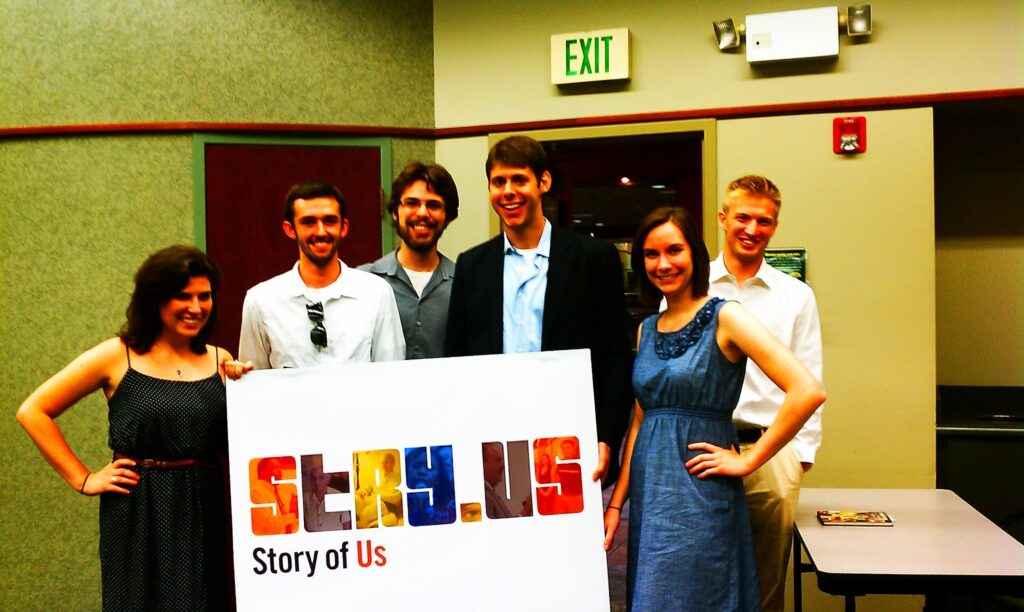
That’s me with the amazing Stry.us team (from left to right): Bari, Zach, Jordan, Sarah, and Roman.
“The things we create tower over us.” — Matt Dopkiss
I was watching an old college football game on ESPN Classic the other day. It was from the 80s.
My mom walked into the room.
“What’s the score?” she asked.
Not sure, I told her.
“How much time is left?” she asked.
No idea, I confessed.
“How many yards do they need for a first down?” she asked.
Uhhhhhh, I said.
There was no on-screen scoreboard. There was no clock. There was no yellow first-and-10 line.
I’d been watching this game for 15 minutes, and I hadn’t the slightest idea what I was looking at. I had a football game in front of me, that much I knew, but I didn’t have any context to understand it.
Early football games — and when I say early, I mean “as recently as 20 years ago” — didn’t give viewers even the most basic information on screen. And as a result, viewers like me often got left in the dark.
“The really important kind of freedom involves attention, and awareness.” — David Foster Wallace
That cartoon at the top of this post is by a cartoonist named Wally Wood, and — the title is kind of a giveaway on this — it’s a list of 22 ways to illustrate a panel in a cartoon.
Consider this: There’s only so much you can do with a cartoon. There’s only so many ways to keep a story going. There’s only so much that’s possible in a tiny rectangle.
Before looking at the Wally Wood graphic, I might have been able to name five or six ways to illustrate a panel.
But 22? I had no idea.
Point is: Whatever you’re thinking about, there’s probably another way of thinking about it. Whatever you’re looking at, there’s probably another way of looking at it.
Don’t get locked into your own perspective. Get out and listen — to friends, to critics.
Let them help you figure out what you’re really dealing with. Let them show you a new side of the problem.
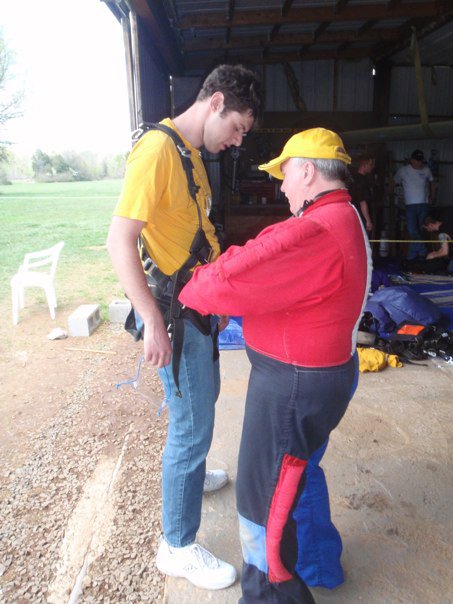
I didn’t do a solo dive. I jumped with a guy. His name was Dave. He was an experienced diver. He was the one who packed the chute, who opened the door to the plane, who yelled, “You ready?”
He was the one who threw me out of the plane, with me attached to his stomach.
I was thankful that he was there. Without him, I can’t imagine finding the courage to jump.
I’m wondering now: How many steps are there in our lives that we couldn’t do alone? How many journeys are there that demand a partner or a mentor?
“Everything around you that you call life was made up by people that were no smarter than you, and you can change it, you can influence it, you can build your own things that other people can use. Once you learn that, you’ll never be the same again.” — Steve Jobs
“I’m so grateful that I struggled.” — Ellen DeGeneres
Those are the words of someone who’s really, truly learned what it’s like to see bottom. Look at her resume, and you’ll find that Ellen DeGeneres has been low places:
• She got into comedy by accident.
• She worked crappy nightclubs and bars. (Once, she worked a restaurant that had the words, “Soup of the Day: Broccoli, and Ellen DeGeneres” on the chalkboard outside. Her name was below the soup.)
• She made it to “The Tonight Show,” where she was the first woman ever to get called over to sit on Johnny Carson’s couch after performing stand-up.
• She made some movies that flopped.
• She got her own TV show.
• On that TV show, she confessed that she was gay.
• The ratings tanked, and her show was cancelled one season later.
• She couldn’t get a job in TV or movies for three years afterward.
And then somewhere in the 2000s, things just started to click. She was in “Finding Nemo.” She got her own talk show. And all that work just started to spin itself into success.
Ellen said those six words at top — “I’m so grateful that I struggled.” — at an award ceremony being held in her honor at the Kennedy Center last month. Sometimes, award ceremony acceptance speeches ring hollow, but this one hit home. And it got me thinking:
What would it be like to be on stage accepting that big award without the lifetime of struggle?
What would it be like to reach success without the bumps and the roadblocks and the failures? Would it mean as much?
When Ellen said she was thankful for the bad times, she meant this: The struggle is when you find out whether or not you’re willing to put in the work. Over the years, after all the criticism and the pain, Ellen found that it was worth it to keep putting in the work — and I think our world is better for it.
Nothing great comes in this world without a lot of work and a lot of struggle.
Embrace the struggle. Embrace the pain.
It’s the stuff that’s molding you and guiding you toward something really amazing.
Inside this month’s Awesome File: Advice! Struggle! Hurricane photo porn! That dude from ‘Inception’ covering Lady Gaga!
1. LEARN: From Jack Donaghy.
If you’re a ’30 Rock’ fan, you already know that Jack Donaghy’s one of the best characters on TV. But it turns out that he’s also offered up some pretty good business advice over the years. These lessons in business management are pretty excellent.
2. REMEMBER: ‘Note to My 25-Year-Old Self.’
And here’s some advice from the real world. It’s from Evonne Benedict, a journalist out in Seattle. She’s got 15 pieces of advice for herself at age 25. I think no. 14 — “Listen. Ordinary people have extraordinary stories if you take the time to listen to them.” — is especially fantastic.
3. READ: ‘The Struggle.
But even if you’ve got that advice in mind, you’ll need to remember something else: It won’t be easy to do great work. Ben Horowitz, an entrepreneur and VC, explains why in this really excellent post, “The Struggle.”
4. WATCH: Derrick Rose Returns.
If you do fight through the struggle, remember that you’re going to get something in return: Your very own comeback story. Here’s Derrick Rose’s, for his return to the Chicago Bulls. It’s pretty epic.
5. CONSIDER: The Sabbatical.
People who do the work — you, included — work damn hard. You hustle. You push. You create.
But oftentimes, you don’t spend enough time stepping back from the work to consider the present — and the future.
And speaking of bad segues: Once you start working on that awesome new thing, you might have some other team members to work with. Consider using Speek for your conference calls. It’s awesome, it’s free and it’s ridiculously easy to use. It’s changed the way I think about conference calls.
7. STARE: These ‘Star Wars’ Posters.
I’m blown away by how gorgeous these “Star Wars” posters are. They’re by Olly Moss, and they’re just amazing. Why can’t the movies companies themselves make posters this amazing?
“Don’t be nervous. Work calmly, joyously, recklessly on whatever is at hand.” —Henry Miller
I had the privilege of going to a TED event last Friday. It was fantastic. Colin Powell gave a talk. So did a guy who marched with MLK. And an opera singer who’s had two lung transplants.
It was an inspiring day. TED promises to deliver “Ideas Worth Spreading,” and Friday most certainly did.
But that’s not what made the biggest impression on me.
No, what made the biggest impression was a conversation I had with a teacher out in the hallway between talks.
It’s a shame, he told me. We’re seeing all these great talks, but what will come from all of this?
What I’d like to see are more TED events that lead to action. Let’s get 10 speakers on the stage to pitch big ideas, and then let’s get the community behind TED to actually make something happen with one or two of the ideas.
There’s a quote in that book that’s fascinating. McCloud talks about the cartoonist’s challenge. You’ve got a handful of panels in which to tell a full story, which means that you can’t show every action. You’ve got to pick and choose the parts you want to show.
Let’s say you’ve got a cartoon of a man at Starbucks. In panel 1, the man might be picking up his coffee from the counter. In panel 2, the man might be yelling while the coffee burns his lips.
What’s amazing is that the brain is able to put together the middle step — somewhere between panels 1 and 2, the man drank the coffee, and the coffee was too hot — even though it’s never actually shown in the comic.
”The phenomenon of observing the parts but perceiving the whole has a name. It’s called closure.”
Basically, if there’s a story being told, and there are loose ends to the story, the brain is capable of closing the loop. It takes the parts it has and jumps to a conclusion.
But what if, in our little coffee hypothetical, what we think happened wasn’t what happened. What if something else happened between the man getting the coffee and the man screaming? We never actually saw the man drink the coffee, after all. Isn’t it possible that something else happened there to cause the man to yell, but our minds had already decided what we wanted to see?
What if our minds closed the loop but changed the story along the way?
So let’s bring this back to you.
If you’re reading this post, you’re someone who’s trying to do awesome work. I salute you, creator of awesome stuff. You’re doing the work we need more of in the world.
But I’m also warning you: The haters are coming for you. Haters love to hate on awesome work.
And your work is no exception.
They’re going to come and see parts of your life’s story. They’re going to see certain things you’ve done or written or said, and they’re going to connects the dots for themselves. This is what McCloud warned us about brains: They like to finish unfinished stories.
You have no control over how they decide to close the loop on your story. It is entirely out of your control.
Here’s more proof that McCloud is right. Jimmy Kimmel sent out a TV camera two weeks ago to document voters’ reaction to the previous night’s debate. There was only one problem:
There wasn’t a debate the night before.
And yet: Here’s 3 minutes of voters responding to a debate that didn’t happen. They took this single bit of information from the cameraman — there was a debate last night! — and whatever preconceived notions existed in their minds, and they closed the loop for themselves:
So here’s what you need to remember: Haters are going to hate. When it comes to your story, they’ve already closed the loop for themselves.
You cannot control the haters, but you can control the work you do.
Focus there. Do the best work you can.
A huge thank you to Ross Nover, who gave a talk last week at Refresh DC that inspired this post. Also: That photo at top comes via someecards.
“Poverty, I realized, wasn’t only a lack of financial resources; it was isolation from the kind of people that could help you make more of yourself.” — Keith Ferrazzi
I was folding my laundry on Monday when I realized something: Right there, in that laundry basket, I could tell that I hadn’t hustled hard enough the week before.
All I was pulling out were T-shirts and jeans and sweatpants. There wasn’t a polo shirt or a pair of khakis or anything with a collar. There wasn’t any dry cleaning for me to pick up later, either.
That’s a bad, bad sign.
Like most people, when I’m going to networking events — dinners, talks, conferences — I try to dress the part. Yeah, I’ve got the word “founder” on my business card, but I’m no Zuckerberg. Hoodies just don’t work for most of my networking events.
But if I get to the end of the week and my decent clothes are still hanging instead of in that laundry basket, I know I just haven’t gotten out enough.
I’ve said this many times before: If you want something really big in life, you need an awesome team behind you.