A Brief Word About Why It Is I Keep Breaking Into Christopher Walken Impressions At Work.

I’ve started commuting for the first time in my life. It’s 25 or 30 minutes round trip on the highway, and for a while, listening to music was enough. Then I started to feel like I was wasting time. If I was going to spend a full 10 hours each month in my car driving to and from work, I might as well do something useful.

So I gave in to my grandfatherly ambitions and decided that I’d listen to books on tape.

I started out with a copy of “Born to Kvetch,” a book about Yiddish, but I couldn’t stand the narrator’s voice; it sounded like a weird cross between Jon Stewart and Stephen Hawking. The narrator took the last vowel of the last word in every sentence and held it two beats too long. I gave up on “Born to Kvetch” after a day.

I’ve since settled in with “Gasping for Airtime,” a memoir by Jay Mohr about his two years on “Saturday Night Live.” It’s not exactly a linguistic challenge, but at 6:15 in the morning, I’m not looking for one. Mohr has a bit of a drone in his voice, but it’s forgivable, because he tends to read lines in the voice of Lorne Michaels or Adam Sandler, and I’ve always been amazed by people who can just break into spot-on impressions.

The only problem with the book is that in the mornings, after 15 minutes of Jay Mohr, I find myself talking like him. We use the same sentence structure. We tell the same stories about Chris Farley. Sometimes, we even start using the same voices.

I want to tell my co-workers, “Look, it’s not me! It’s the audiobook’s fault! I don’t really talk like this!” But I’m not so sure they’d understand.

So I’ve made a decision: I’ll keep listening to audiobooks, but not by writers with usual voices or narrating styles. From here on out, I’m picking audiobooks with cool sounding narrators, guys like James Earl Jones or Samuel L. Jackson, or at least ones that feature inspiring stories from Vince Lombardi or Winston Churchill.

I want to walk into work in the morning, my voice booming, and have co-workers ask: “What the hell happened to you?”

I want to be able to look back at them and cry out: “I commuted!”

Mojo.

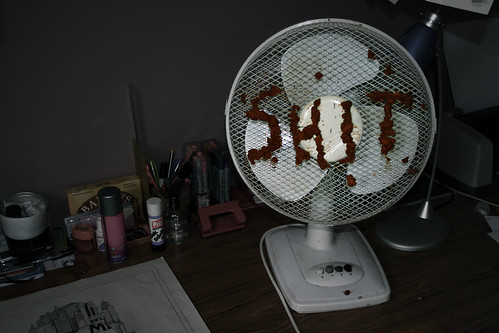
Sorry for the slow week of blogging here at danoshinsky.com. I’m working on a big piece that has to with the photo above — and this book. Should be up later in the week.

The San Antonio Theory of Relativity.

Ignoring the contradictions and laziness in general sentence structure for just a moment, I’d like to suggest that context is everything. [1. Technically speaking, “context is everything” makes no sense, because placing something within context means taking it out of the general text and inserting into a more specific subtext, which does not and can not encompass the whole of everything. But that’s just semantics and me taking an idea entirely too far. Too far out of context, really.]

When I was a kid, a 45 minute drive to Baltimore was an interminable exercise. Maybe it was just childhood antsyness [2. This does not appear to be an actual word.]; maybe it was just that at that point in my life, 45 minutes amounted to a fairly significant chunk of my existence. But when I went to school out in the Midwest, my concept of time changed. Suddenly, an hour and a half seemed like the normal amount of time it should take to drive to the nearest airport. Strangely, a four hour drive to Omaha seemed short. Oddly, at the end of a two-day, 23-hour marathon from Phoenix, I found myself saying, “Wait, it’s already over?”

So time became relative within the particular regional context. The Midwest is enormous; it’s no surprise that people there have to tailor their concept of time to local geography.

Which is why I find it strange that in Texas — a state that touts itself with the tagline “Everything’s Bigger in Texas” — their concept of relativity is so different.

It’s true: they embrace big here. The people are, on average, morbidly obese. Their trucks have beds that extend beyond the limits of modern metallurgy. The two biggest Jumbotrons in the world are in this state.

And yet, there is one thing that Texans do not like more of: walking.

I’ve seen locals happily pay $10 to park a block from the Alamo, even though just two blocks from the landmark, there’s street parking available for a quarter (which buys you 75 minutes in the meter). I’ve seen Texans sit in their cars for twenty minutes at a drive-thru, even though they could just as easily get out of their cars, walk into the restaurant and leave in a third of the time.

But nothing compares to what I saw last Saturday at the AT&T Center, home to the San Antonio Spurs and the Silver Stars. I went to go see the latter play in a WNBA game last Saturday.

Upon arrival, I pulled into the AT&T Center parking lots. There were two lines of cars waiting to enter the lots. Actually, that’s not entirely true: there was one massive line of cars, and there was another lane that was completely empty.

The lane on the right was for the $8 parking that’s closest to the stadium. That lane was filled. The lane on the left — the empty lane — was for $5 parking farther away from the stadium. (For the visually-inclined, note the infographic above.)

So, logic suggests, the $5 lots must’ve been infinitely farther away from the stadium to warrant a discounted price — and a lack of interest from fans. And thanks to Google Maps, I’ve done the calculations.

Based on the approximate location of my parking space in the $5 lot, I walked a distance of about 0.14 miles from my car to the stadium’s entrance. Had I parked in the pricier lot, I would have walked a distance of about 0.08 miles — or less.

I can only assume that eventually, the AT&T Center will began offering even more expensive parking — perhaps for $20 or even $50 — in which fans will have the opportunity to allow their muscles to completely atrophy as an airport-style moving sidewalk guides them into the stadium. We can only hope.

What Journalists Can Learn From the Dallas Cowboys Cheerleaders.

More than Dirk Nowitzki or the hole in the roof of their stadium or even the words “Who shot J.R.?,” I think the thing the majority of Americans connect with the city of Dallas is their cheerleaders. And it’s a strange thing, really, because cheerleaders are so ubiquitous now that one exclusive group of females in north Texas shouldn’t make such an impression on Americans. Every sports team in this country has a squad of short short-wearing ladies, but somehow, the Dallas Cowboys cheerleaders have become the preeminent name in cheerleading (even moreso, perhaps, than L.A.’s famed Laker Girls).

And if not for the Radio City Rockettes, the Cowboys cheerleaders would be the most famous high-kicking organization in the entire country.

But there’s something odd about group so visible despite the fact that they perform only eight times a year (not counting preseason or playoff games). Somehow, they’ve managed to take cowboys boots and the simplest color scheme this side of Syracuse University and turn it into a cheerleading empire.

That’s why the Dallas Cowboys cheerleaders are the focus of this installment of “What Journalists Can Learn From….”

1.) The Brand Comes First.
Quick, off the top of your head, name one member of this year’s Dallas Cowboys cheerleading squad? How about any cheerleader on the squad dating back to the squad’s inception in 1972? You can’t, because the squad isn’t about individual achievement. The Cowboys cheerleaders are a brand, one of the most powerful ones in sports. They’re carefully managed to make sure that the brand — not the individual members — is the star.

Now look at a news organization like Politico. They’ve managed to connect their brand with politics, and with great results. When one of their writers breaks a story, it’s hailed as a victory for the entire organization, because at Politico, the brand comes first.

2.) Sell It — Across Platforms. Throughout the team’s history, the Cowboys have done a remarkable job of marketing their cheerleaders. Their cheerleaders have appeared in swimsuit calendars (in print and on TV), toured internationally and even had their own feature film (starring, quite naturally, Jane Seymour.) The Cowboys cheerleaders were platform agnostic long before the concept even really existed. They’re a model for journalists willing to brave the multi-platform world.

3.) Be Visible in the Community. I don’t think journalists are doing a good enough job actually making their way into the community and interacting with the public. Some are doing a good job of it digitally — N.B. The Washington Post’s ‘The Fix’ — but actually getting out of the newsroom and being visible is another matter. It’s one thing that the Cowboys cheerleaders excel at, especially when it comes to showing up at public events or youth camps. For journalists, maybe it means attending more forums or speaking at schools. But whatever it is, journalists have to do a better job of reminding people that we’re out there, working for the public good.

Of course, there’s one more thing that any journalist can learn from the Cowboys cheerleaders: whatever it is you’re putting out in the public sphere, make sure it really kicks.

❡❡❡

H/T to KENS 5’s Jeff Anastasio for the photos.

Extreme Makeover, Blog Edition.

Pardon Our DustThe blog has relocated to, well, the exact same address. But it looks different. And the font is a little bigger, which my parents will immediately assume is a backhanded way of me reminding them that their vision is decaying due to old age.

To which I say: I could’ve made a balding joke instead, pops.

I’ll now return you to your irregularly scheduled blogging.

(H/T to Omid Tavallai for the photo of the sign at right, which translates roughly as ‘Pardon Our Dust’ in Japanese. Anyone else a bit weirded out about the cartoon man’s belt-over-the-suit-jacket combination?)

UPDATE: Why Twitter Has Killed Small Talk.

In April, I wrote a blog post in which I suggested that “we, as Americans, are quickly becoming less interesting. Naturally, I would like to blame Twitter for this decline.”

The diagnosis was simple: as Twitter allows us entry into the lives of friends and loved ones, we’re seeing thoughts both mundane and profound in real time. So when we meet up with a fellow Twitter user in person, we’re finding that the day-to-day details that’d usually make up small talk aren’t really pertinent anymore, because we’ve already read about them on Twitter. And, as such, Americans who use Twitter are finding out that we’re pretty boring.

But now, a doctor — well, a PhD who appears on the “Today” show, at least — is supporting my claim.

He goes on to suggest that social media tools like Facebook are killing couples:

“A sense of separateness and “not knowing” is scary, but it’s also essential to attraction. The conventional wisdom tells us that in relationships there should be no secrets, there should be nothing to hide — but if nothing is hidden, then what is there to seek? When you’re in a long-term relationship, you don’t need more information about your partner, you need less.”

The key to a long-lasting friendship, apparently, starts with de-friending.

What’s Black and White and Dead All Over? The Early Printed Edition of the Sunday Paper.


I saw something at the gas station today that I didn’t even know still existed: the early edition of the Sunday paper.

On Fridays, the San Antonio Express-News prints an advance copy of their Sunday paper. It’s almost all feature stories, plus the fluffy stuff that stays evergreen: comics, crossword puzzles and coupons.

But as much flack as newspapers get for their printed edition — even my dad’s started to realize that by the time you’ve opened the paper at 8 a.m., that news is a day old — the early Sunday edition seems even more dated.

Here’s proof: this week’s lead story in the Express News‘ early Sunday edition is about the continued success of the ‘cash for clunkers’ program, which — in the time it took to print that Sunday edition — ran out of money and went back to a vote before the House to get extra financing.

So here’s to you, early Sunday edition of the paper: thanks for making the daily printed edition seem so fresh.

What Journalists Can Learn From the Free T-Shirt Giveaway.


There are few advantages to being 6’6” and unable to dunk. Three come to mind: 1.) It makes it easy for people to find me at crowded social events; 2.) It makes it easy to dust hard-to-reach places; and 3.) It gives me a decided advantage when catching t-shirts at sporting events.

In my lifetime, I’ve caught far more free t-shirts than I deserve, and it’s mostly been because I have the wingspan of someone who’s 6’9”. But when I catch a free t-shirt, I don’t just toss it in a dresser somewhere. No, I wear that Verizon-sponsored Washington Capitals shirt for about three to six months longer than public decency will allow.

And I know I’m not the only one obsessed with the concept of ‘free.’ I’ve seen it at sporting events throughout my life: people will do anything for a free shirt, no matter how obnoxious it looks or how oversized the advertisement on the back is.

That’s why the free t-shirt giveaway is the focus of this installment of “What Journalists Can Learn From….”

1. You’ve Got to Make People Want It. Last year, at a Mizzou basketball game, a fellow student dove face first into the row in front of me to catch a foam finger that had been dropped from the rafters. It was just a yellow “We’re #1” finger with a massive logo for a local business on both sides, but the student nearly came up concussed in his bid for the thing. Now, maybe we’re not looking for the public to risk bodily harm to get their hands on news, but certainly, we need to entice them with strong content that consumers are willing to seek out.

2. Engage Consumers Wherever They Are. Just a decade ago, you had to be within the range of a strong-armed cheerleader to catch a shirt. Then the slingshot came around and expanded the number of fans that could catch a shirt. And then the t-shirt cannon was invented, making it so that fans seated in the upper deck of a pro stadium could catch a shirt. The idea here is simple: engage the widest audience possible while still keeping a focused message. We’ve got our t-shirt cannon: the Internet. Journalists just need to harness that power to better distribute the news.

3. Free Can Be Desirable. Sure, the shirts are ugly, and no, I don’t really want a foot-wide Papa John’s logo on the front of the garment I’m wearing to every game. But if the option is a free shirt or a $25 one available at the team’s store (geez, talk about a pay wall), you can understand why fans are so willing to stand up or even dive for a free one. But think of it this way: on free t-shirt days at the ballpark, teams won’t bring out the t-shirt cannon. Why? It’s because fans won’t care; they’ve already gotten what they wanted. The shirts are only desirable if it’s the only free option.

So maybe media should be creating targeted, premium content — that, just maybe, consumers will be willing to pay for — while still engaging the rest of the crowd with free, non-niche news. (And I can’t imagine that Rupert Murdoch would be pleased to hear that his business model is being replicated by interns in mascot costumes around the country this summer.)