I’m Dan Oshinsky, and I run Inbox Collective, an email consultancy. I'm here to share what I've learned about doing great work and building amazing teams.
There is a phrase I use a lot. I overuse it. A lot of my friends do, too.
The word is “fail.”
Fail can mean a lot of things. It can mean:
-Go try hard things, and see what works!
-Don’t be afraid to mess up!
-If it doesn’t succeed, that’s okay — it doesn’t mean you’re a failure!
But sometimes, when we just wrap all that in into that one word — fail — we lose a sense of what we’re really trying to say. Sometimes, I’ll find myself telling people that they should be willing to fail, and they think, “Dan doesn’t think I can do it.”
And that’s not it at all! If you’ve got the skill and hustle and the team, you can absolutely pull it off.
So if I’ve told you, “It’s okay to fail” or “Go fail fast,” I’m sorry. I can say it better.
This year, be willing to do difficult things. Be willing to go on adventures where you don’t know the outcome. Be willing to persevere.
-Travel more — I got out to Austin, New York, New Orleans, Denver and Vancouver. Not bad. -Speak publicly — I gave a TEDx talk, and I hosted a talk at a big journalism conference. -Ship things — This one I really took to heart. This year: Tools for Reporters. Very Quotatious. And a whole bunch of Stry.us related stuff.
Now with 2012 almost finished, I’m looking toward 2013. Seven things are on my list:
Build more stuff — with others.
Learn new web tools.
Follow up better (with friends/colleagues).
Spend more time outdoors.
Make more time for art (theater, museums).
Be patient.
Do good.
Most of that stuff is pretty self-explanatory, but to take the final one a step further:
As I look at 2013, I want my work to reflect one thing: A desire to do good for others and our world. I want to make stuff that makes our world more good. And by that, I mean: I want to do work that helps move us forward. I want to do work that makes our world a more pleasant place.
And in everything I do, I want that spirit of “good” to be present.
Doing work is a wonderful thing, but to do work that helps make our world a little better — that’d be amazing.
Here’s a section from part of the Lakers’ playoff run that season. Jackson had been critical of Shaq’s free throw shooting abilities. (That playoffs, he shot 109 of 254 from the line.) Here’s what Jackson had to say about one pre-game effort:
“The press made a big deal out of [Shaq’s] dedication, showing up at the arena today three hours before tip-off to work on his free throws. To me it was no big deal. That was exactly what Shaq, as a professional, should be doing.”
And… he’s absolutely right.
Where else but in sports do we hear about how hard people practice? We don’t praise the coders who spend weekends diving into the craft. We don’t compliment the writer who stays up late working on drafts that never get read.
“Don’t give up. Don’t ever give up.” — Jim Valvano
I have seen Jim Valvano’s speech at the ESPYs 100 times now. Maybe more. Probably far more, actually.
I’ve seen it on TV, and I’ve watched it for inspiration on my laptop. I once saw it played on the JumboTron at Madison Square Garden — even the beer vendors stopped for 10 minutes to watch.
It is, simply, one of the most marvelous, most inspiring, most deeply human things I have ever seen.
And for people like me — namely, people who enjoy public speaking — it’s a speech that can be watched over and over. I’ve studied it. I’ve wondered: How does he command a room like that? How does he deliver a speech like that?
Three things stand out to me about the speech:
1. His Poise on Stage — People forget this, but at the start of the speech, Jimmy V tells an opening joke about Dick Vitale — and it bombs! But he presses on. His facial expressions, his voice — they never waver in this speech. He demands attention with his voice, and he commands the stage by moving left to right, pointing at the crowd, throwing his arms around. He owns that stage. He’s got a few scripted lines ready, but mostly, he’s talking off the cuff. That really resonates here.
And when the ESPN cameras try to get him off the stage, and he tells them to screw off? That’s a raw moment in which Jimmy V wins the room. That’s the moment when the speech tips from great to epic.
2. His Use of Rhetorical Devices — He does two great things here. The first is his use of the Rutgers anecdote. It takes up the middle chunk of the speech, but it’s got a killer closing line, and it really humanizes him. For a few minutes, you get to forget that this is a guy who’s dying of cancer. For a few minutes, he’s a coach — speaking to a room of athletes and coaches, and a nation of fans watching on TV.
He also breaks out two great sets of three: “If you laugh, you think, you cry, that’s a full day,” and “[Cancer] cannot touch my mind. It cannot touch my heart. It cannot touch my soul.” Orators know: If you want to connect with someone, do it with a series of three.
3. The Call to Action — And here’s what so many speeches miss. So many speakers deliver great moments. They make the audience laugh. They make the audience think.
And then they walk off.
Jimmy V doesn’t. He closes with the biggest thing: A call to action. Donate, he says, to my new foundation. Help us find a cure. It will not save my life, but it may save yours.
The call to action is the reason why ESPN can play this speech every single year during their Jimmy V Week. Every year, even though us sports fans have seen the speech more times than we can count, Jimmy V asks us to donate.
Nearly twenty years after he first gave the speech, we still can’t say no to Jimmy V. The speech is just that great.
2. QUESTION: The Rhetorical Question Gets a Workout.
Speaking of New York: Here’s the Guy Fieri food review everyone was talking about last month. It was written entirely with rhetorical questions. And it reminded me a lot of “The Interrogative Mood,” by Padgett Powell. That’s a novel written entirely in rhetorical questions, too. It’s definitely an interesting — or maybe “unusual” is the better word — kind of read. And it’s proof that a novel doesn’t have to be what you always thought it could/should be.
3. SMILE: The Oatmeal’s Thoughts For People Who Make Stuff.
And here’s something for Guy Fieri — and the rest of us who make stuff — to keep in mind. The Internet is a wonderful place. It is also terrifying place. Navigating it isn’t easy. So The Oatmeal has some truly wise words for those of us who make things on the web.
So work’s getting hard this week? Consider this: We just achieved teleportation. Yeah, that’s right: TELEPORTATION. When you start complaining about your work, just remember: You didn’t have to solve the problem of freaking teleportation.
10. LISTEN: Steve Poltz’s ‘Stairway’/’Gilligan’ Mash-Up.
And then here’s something really weird: It’s a mash-up of Zeppelin and the “Gilligan’s Island” theme. Some of the best stuff doesn’t always seem like it goes together — but then you see/hear it together, and sure enough, it does. And here, Poltz pulls it off.
Now go out there and do some great work this month.
“Time will magnify whatever you do. So even in the smallest matters, do what is right. — Ralph Marston
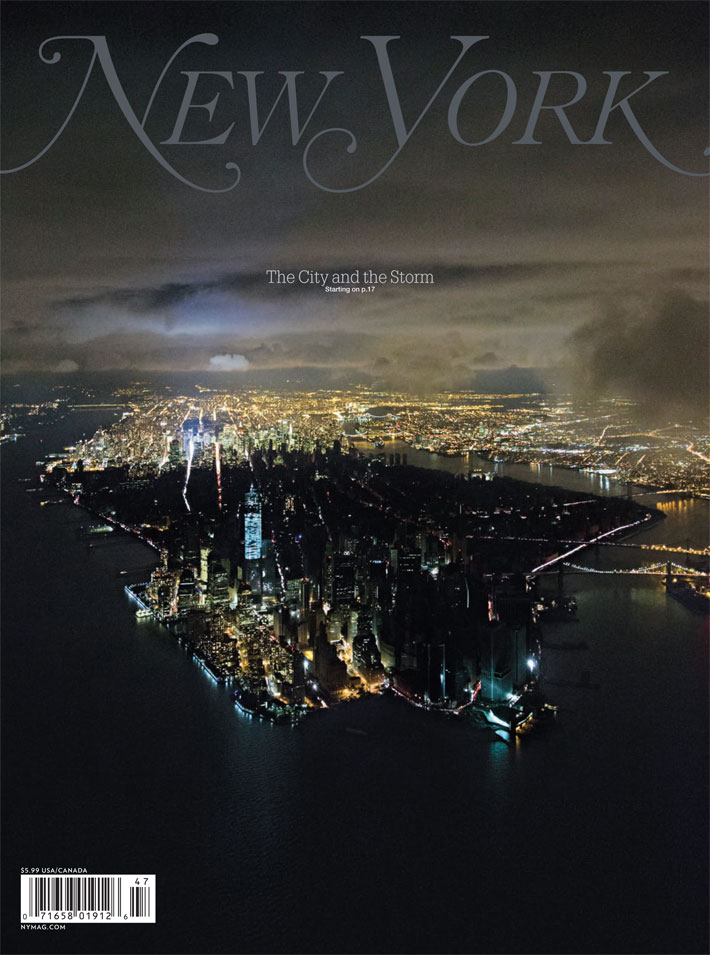
39 days ago, Hurricane Sandy hit New York City.
It came. It flooded.
But now the city — Manhattan, at least — is back to normal. Next week, I’ll grab the keys to a New York apartment. It’s three blocks from the area that was evacuated during the storm, and a quarter mile from the power plant explosion that knocked out power to half the city.
You’d never even know. I was there last week, and the neighborhood looked totally normal. Five weeks changes a lot.
Time has a way of doing that. It’s been 1 year, 6 months and 15 days since the Joplin tornados. It’s been 7 years, 3 months and 1 day since Hurricane Katrina hit the Gulf Coast.
And there’s this: Tomorrow, we’ll recognize the 71st anniversary of the attacks on Pearl Harbor.
Of course, we won’t be talking about Sandy or Joplin or Katrina tomorrow. We’ll be talking about what happened that day in 1941 in Hawaii.
But here’s what I find most interesting: On big anniversaries, we always seem to ask the same question: How do we remember? We talk about what happened that day. We interview those who were there.
But I’m not so sure we’re asking the right questions.
I’d rather ask:
–Why do we remember?
–What did we learn?
–What do we know now?
We focus so much on the date itself, but on anniversaries, it’s often what’s changed since that really matters.
If we really want to remember, we need to ask better questions. I know that’s what they’ve done in Biloxi, Joplin and Hawaii. I hope it’s what they’re doing in my new neighborhood in New York.
It’s the way we get better.
That photo of flooding in my new neighborhood comes via David Shankbone.
I’m going to join them as their first-ever Newsletter Editor. I’ll be working out of their New York office. I am pretty freaking excited about this.
If you’re not all that familiar with the company, here’s what you need to know: BuzzFeed is built around the idea that great stories deserve to be shared, and they’ve made a major push into social networks like Facebook, Twitter, Tumblr and Pinterest.
But for the most part, they’ve stayed out of the email game.
No more.
I’m a big believer in email. I think it’s an underutilized tool. Consider this:
But email? There are 3.1 billion email addresses in the world. [1. Yes, I know. That includes spam accounts. But then again: Those other social network numbers are inflated, too, by fake accounts and non-active users.]
Email is — by a huge margin — the most widely-used network for sharing information, ideas and content.
And yet, among news organizations, it’s a tool we’ve largely ignored. When we talk about social networks, we mention Facebook and Twitter and whatever network just launched in beta last week, but we always leave out email.
I think that’s a mistake — so at BuzzFeed, we’re going to prove just how valuable email can be.
We’re going to use that giant email network to make sure that you can see the silliest cat photos the Internet has to offer. [2. Plus: We’ll be sharing lots of serious news, and many awesome non-feline stories.] We’ll be building out some new products just for email, and we’ll be doing lots of experiments to make sure that we get the best, most shareable content into your inbox.
“Slump? I ain’t in no slump. I just ain’t hitting.” — Yogi Berra
Over the years, I’ve developed a sixth sense for certain things during sporting events. Like many sports fans, I know exactly when to flick back to the game after a commercial break. Like other sports nuts, I can usually tell you the cliché the announcer is about to spout just before he spouts it.
And of course: I can tell you when one team has the Mo.
You know Mo, or maybe you know it by one of its pseudonyms: Uncle Mo. Mighty Mo.
Big Mo.
Mo is momentum. Mo is how teams make comebacks that don’t seem possible. Mo is how the hot goalie gets hot, and why the power hitter suddenly can’t swing the bat. Mo is that mighty force that can upend even Murphy’s Law.
You can have skill, strength, strategy and coaching, but if you don’t have Mo, you’re not going anywhere.
I’ve seen it with my own eyes: Some nights, Big Mo just gets rolling, and crazy things start happening.
Yes, you read that right: It takes a full year for United Airlines to get a new meal option onto a flight. It takes a full year — 12 months, 365 days, 525,600 minutes —
to create a new food option and get it ready to be served on a United flight.
And to think: Many of us who’ve eaten these meals would hardly classify them as “food.”
One year. I’m hung up on that number. That’s an awfully long time to institute a tiny change to an airline menu, isn’t it?
I’ll ask you now: What if they could do it in a day? What if they could do it better?
But what if United just simplified their list of ingredients to include things that can be found at any airport kitchen in the world? What if United only cooked from that list?
And what if United changed its menu every day, with United’s head chefs emailing out that day’s menu options?
And what if — because yes, local flavor is important — United empowered local chefs to add an ingredient or two from the departure airport to personalize the flight? (Sushi from Japan, hummus from Tel Aviv, cheddar cheese from Milwaukee.)
What if United focused on going fresh every day, and creating a beautiful meal presentation for all of its passengers?
What if United decided to spend a little more on airplane food? As of 2010, United spent about $6.35 per meal per passenger — is that enough for passengers who’ve paid hundreds or thousands of dollars for a seat?
What if United decided that while every other airline cuts back on meals, they’d make it a priority? What if passengers actually looked forward to their meals on the flight – because they knew it was made that day, and made specifically for them that day, not dreamed up in a kitchen a full year earlier?
I know what you’re thinking: Yeah, but… they’d never go for it. It’s too complicated. Too costly. Too hard.
And I say: Every day, United moves thousands of people around the world. You’re telling me they can’t think of a better way to serve us salad and sandwiches in the sky?