What Is Long, and What Is Not.

“The NFL isn’t a career — it’s an experience. Most careers last 40-50 years, and people grow old in them.” — Alfred Morris

 
Two things got me thinking:

The first is that quote, at top. It’s from Alfred Morris, the rookie running back for the Washington Redskins. (That’s a photo of him sleeping on the couch. He still sleeps on the couch when he visits his parents.)

NFL players don’t usually have that kind of awareness, but Morris really seems to understand what’s happening in his life. The NFL is something most players have worked for since they hit puberty. It’s all they’ve worked for. The idea that it wouldn’t be forever is…. well, impossible.

Understanding what the NFL is — a job, an experience — and what it is not — a career, a lifestyle — is going to change everything for Morris. It’s going to let him make the most of this incredible opportunity.

But most of us can’t tell the difference between what is big, and what is not. We see a half an inch of water and we tell ourselves we’re going to drown. We hit a bump and think it’s a mountain.

We lack perspective, and that’s one thing we need most to understand the road we’re on and the places we’re headed.

There’s a second thing. I had a Latin teacher in high school, Miss Cherry. One of her quotes comes to mind now: Ars longa, vita brevis.

Art is long, but life is short.

And in high school, I remember thinking: What the hell is that? Art is long?

LONG?!

But that’s exactly what Morris is talking about, too. It’s this idea that some things are forever, and some things fade away.

The memories are long, but the job is short.

The ambitions are long, but the opportunities are short.

We work to build things that are long — but ultimately, the one thing we know is that the chances to make them are short.

Make things now, with the time you have now. To wait is to discover that now is very, very short.

Photo at top of Morris comes via the Washington Post.

Go On.

“There is a direct relationship between your ability to handle uncertainty and your happiness.” — Joshua Fields Millburn

 
We’re all going to make mistakes in our work. We’re going to go directions we didn’t expect. We’re going to make choices we don’t like.

It happens.

But here’s what happens next: It’s normal for us to ask forgiveness of others. We make a wrong choice that hurts someone else, and we tell that person, I’m sorry.

That’s normal.

What doesn’t happen, I’ve found, is that we forgive ourselves for the mistakes we make in our own work. I know I’m guilty of this myself: Something goes wrong in my work, and I won’t let it go for months.

I have to learn how to forgive myself for making the mistakes that I know I’m going to make along the way. Screw ups happen. It’s okay.

And it’s not like the screw ups were in vain. I really have learned from many of my mistakes. They’ve taken me a step further in my work.

Sometimes, I’ll look back on these mistakes with amazement.

You did THAT?

You chose THAT?

You said WHAT?

Yes, mistakes happen. And I know now: Time makes things better. Time lets you move on.

But you have to find ways to move on long before then. Otherwise, your work gets held up along the way.

Life goes on, no matter what the hell you do. It really does.

Give yourself permission to go on, and then get on with it.

I Need A Race.

Superman

“If you’re the smartest person in the room, you need to find a better room.” — Chris Conrey

I’ve been going to the gym for a few weeks now without a goal.

At the gym, especially, goals are huge. Last year, I had the Belly Challenge. And then I had the sprint tri.

Both gave me something to work for. Something to strive for.

Without a goal, I now find myself aimless at the gym, spending 30 minutes on the bike, or 20 minutes on the elliptical, and calling it a workout.

Sometimes, I won’t even break a sweat.

Seriously, Dan?

I need a new race. I need a new challenge.

All of us do, I think.

Without new goals to shoot for, we get stagnant. Our work gets lazy.

If you’re not setting and re-setting the bar, what the hell are you doing? Are you getting better?

I know that right now, I’m not.

So I’m picking a 5k for the spring. I’m giving myself something to shoot for.

I suggest you do the same. We all need a race to run.

Photo at top via.

Waiting Sucks.

“Find what moves you, and move. Find what keeps you up all night, and stay up all night.” — Nicole Antoinette

 
There is so much I want to do this year. So much to take on.

There really is no time to waste.

But more importantly than that: This is no time to wait.

Waiting sucks. Sitting around, waiting for other people/things/events to come around before you can do your work — that’s no good at all.

Or more likely: Waiting for the moment when you give yourself permission to start doing the work — that’s even worse.

So start now. Start with what you have. Start with as little as you need.

Waiting sucks. Find a way to get yourself moving.

What Really Matters.

“To practice courage and compassion is to look at life and the people around us, and to say, ‘I’m all in.'” — Brené Brown

 
What really matters in this life?

People. That’s it.

Get good people in your life. People who lift you up. People who challenge you. People who help make you you.

People matter.

Money, anger, jealousy, things — the rest of it is just filler.

Find good people, and you’ll understand what makes this life all it can be.

What I Really Mean When I Say ‘Fail.’

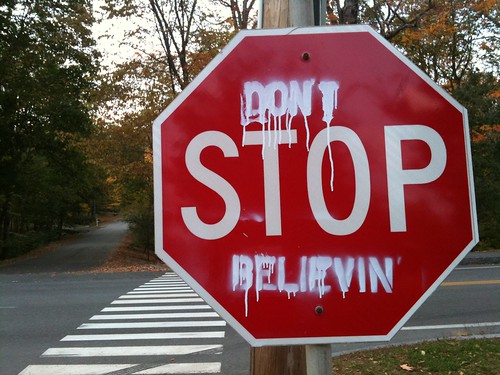
Don't Stop Believin'

There is a phrase I use a lot. I overuse it. A lot of my friends do, too.

The word is “fail.”

Fail can mean a lot of things. It can mean:

-Go try hard things, and see what works!
-Don’t be afraid to mess up!
-If it doesn’t succeed, that’s okay — it doesn’t mean you’re a failure!

But sometimes, when we just wrap all that in into that one word — fail — we lose a sense of what we’re really trying to say. Sometimes, I’ll find myself telling people that they should be willing to fail, and they think, “Dan doesn’t think I can do it.”

And that’s not it at all! If you’ve got the skill and hustle and the team, you can absolutely pull it off.

So if I’ve told you, “It’s okay to fail” or “Go fail fast,” I’m sorry. I can say it better.

This year, be willing to do difficult things. Be willing to go on adventures where you don’t know the outcome. Be willing to persevere.

Most of all: Be willing to do great work.

Yes, some of the work won’t live up to your standards. Yes, yes, some of the work will take you directions you didn’t intend.

What matters is you and your work, and that you keep going.

The only true failure comes when you decide that the work isn’t worth it anymore.

Everything else is just a stop along the way.

Practice Isn’t Optional.

“You really can see what makes up a winner when you put them in a lose lose situation.” — Mike Germano

 
I really like Shaquille O’Neal. I’ve written about him before on the blog. I even created a site inspired by one of his quotes.

But I’ve been reading Phil Jackson’s book about the 2003-2004 Los Angeles Lakers — the team that Jackson coached — and it sheds some interesting light onto Shaq’s behavior.

Here’s a section from part of the Lakers’ playoff run that season. Jackson had been critical of Shaq’s free throw shooting abilities. (That playoffs, he shot 109 of 254 from the line.) Here’s what Jackson had to say about one pre-game effort:

“The press made a big deal out of [Shaq’s] dedication, showing up at the arena today three hours before tip-off to work on his free throws. To me it was no big deal. That was exactly what Shaq, as a professional, should be doing.”

And… he’s absolutely right.

Where else but in sports do we hear about how hard people practice? We don’t praise the coders who spend weekends diving into the craft. We don’t compliment the writer who stays up late working on drafts that never get read.

Look: Great work only comes through hours and hours of practice. It’s not optional. And it’s not something that’s going to earn you a pat on the back.

It’s expected.

Show up early. Practice hard. Get at it.

Today’s a chance to get better.

Say *Something* With Less.

“Be quick, but don’t hurry.” — John Wooden

 
I am guilty.

I have used 50 words where five will do. I have used entire paragraphs when words like “yes” or “no” or “I agree” would have sufficed.

Forgive me, friends. I have not always been brief.

But I am reminded, again and again, that brief can be wonderful.

Here’s Derek Sivers, who delivers a TED talk — and all the inspiration and genius that comes with it — in less than three minutes:

Here’s Patrick Ewing, a tech guy at Twitter, who manages to sum up the way I do work in a single sentence:

Here’s Joel Plaskett, who explains why growing up sucks in a song that clocks in at under two minutes:

The good old days
Well I suppose, I’m glad they’re behind us now
The only thing worse than growing up
Is never quite learning how

So that’s the first thought: We can all be more brief.

Here’s a second: There’s an expression probably you’ve heard before — “Do more with less.” But that’s not quite it.

What matters is not that you do more. It’s that you do something.

It’s not the size of the action that matters — only the action itself.

Do something. Take a baby step. Today, a simple, small thing can be truly powerful.

I’m not entirely sure what’s happening in the photo at top, but it comes via @kitkat_ch.

The Might of Mo.

“Slump? I ain’t in no slump. I just ain’t hitting.” — Yogi Berra

 
Over the years, I’ve developed a sixth sense for certain things during sporting events. Like many sports fans, I know exactly when to flick back to the game after a commercial break. Like other sports nuts, I can usually tell you the cliché the announcer is about to spout just before he spouts it.

And of course: I can tell you when one team has the Mo.

You know Mo, or maybe you know it by one of its pseudonyms: Uncle Mo. Mighty Mo.

Big Mo.

Mo is momentum. Mo is how teams make comebacks that don’t seem possible. Mo is how the hot goalie gets hot, and why the power hitter suddenly can’t swing the bat. Mo is that mighty force that can upend even Murphy’s Law.

You can have skill, strength, strategy and coaching, but if you don’t have Mo, you’re not going anywhere.

I’ve seen it with my own eyes: Some nights, Big Mo just gets rolling, and crazy things start happening.

And no, Mo isn’t just a force limited to the playing field. I’ve seen businesses turn one big deal into another. I’ve seen musicians spin one big break into a second, and a third.

But Mo isn’t merely luck. That’s a misconception. It’s a strange combination of forces: Of good breaks, of confidence, of practice, of skill.

Mo doesn’t just happen. Mo is earned.

Mo happens to all of us. It comes — it really does. Some of us just have to be willing to fight a little longer to earn it.

Keep fighting. Keep working.

Your hour of Mo will come. I promise.

That photo of Mizzou’s Big Mo drum comes via @racerx617.

Why Does It Take So Long For United Airlines To Come Up With New Menu Ideas? (And Should It?)

Yes, you read that right: It takes a full year for United Airlines to get a new meal option onto a flight. It takes a full year — 12 months, 365 days, 525,600 minutes —
to create a new food option and get it ready to be served on a United flight.

And to think: Many of us who’ve eaten these meals would hardly classify them as “food.”

One year. I’m hung up on that number. That’s an awfully long time to institute a tiny change to an airline menu, isn’t it?

I’ll ask you now: What if they could do it in a day? What if they could do it better?

United Airlines flies to 186 destinations. Their big issue is that some ingredients — like Wisconsin cheddar cheese —are easy to get domestically, but impossible to get in places like Dubai. And the meals are made at the departure airport. That means that United needs lots of different menu options that can best take advantage of ingredients available near the departure airport.

But what if United just simplified their list of ingredients to include things that can be found at any airport kitchen in the world? What if United only cooked from that list?

And what if United changed its menu every day, with United’s head chefs emailing out that day’s menu options?

And what if — because yes, local flavor is important — United empowered local chefs to add an ingredient or two from the departure airport to personalize the flight? (Sushi from Japan, hummus from Tel Aviv, cheddar cheese from Milwaukee.)

What if United focused on going fresh every day, and creating a beautiful meal presentation for all of its passengers?

What if United decided to spend a little more on airplane food? As of 2010, United spent about $6.35 per meal per passenger — is that enough for passengers who’ve paid hundreds or thousands of dollars for a seat?

What if United decided that while every other airline cuts back on meals, they’d make it a priority? What if passengers actually looked forward to their meals on the flight – because they knew it was made that day, and made specifically for them that day, not dreamed up in a kitchen a full year earlier?

What if — instead of getting the menu absolutely perfect months in advance — United focused on delighting its customers every single day?

I know what you’re thinking: Yeah, but… they’d never go for it. It’s too complicated. Too costly. Too hard.

And I say: Every day, United moves thousands of people around the world. You’re telling me they can’t think of a better way to serve us salad and sandwiches in the sky?

I’ve said it before and I’ll say it again: Work is a differentiator in this world. Hustle is a differentiator in this world.

Everything else is just excuses.

In whatever you do: Do great work. Surprise us. Delight us.

Even you, United Airlines.

That photo of airplane food at top comes via @tiffkathlee.