Sometimes, We Need Other People To Help Us Make the Leap.

“There are three diseases in Panama. They are yellow fever, malaria, and cold feet; and the greatest of these is cold feet.” — John Stevens

 
Last year, I wrote about the time I went skydiving. I surrendered to the fear, I said, and jumped.

But that’s only part of the story.

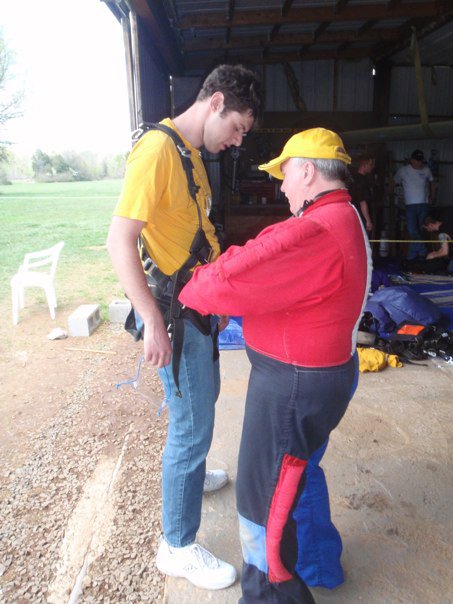
I didn’t do a solo dive. I jumped with a guy. His name was Dave. He was an experienced diver. He was the one who packed the chute, who opened the door to the plane, who yelled, “You ready?”

He was the one who threw me out of the plane, with me attached to his stomach.

I was thankful that he was there. Without him, I can’t imagine finding the courage to jump.

I’m wondering now: How many steps are there in our lives that we couldn’t do alone? How many journeys are there that demand a partner or a mentor?

We all like to think that we’re strong enough to go it alone. But with the right team behind us, we’re capable of so much more.

Together, we can reach for the skies – or, with the proper equipment on our backs, jump from them.

The Three Things That Separate Those Who Do From Everyone Else.

“Ignore the money and the news. Find good people who make wonderful things, and help them do it.” — Erin Kissane

About once a month, I get an email from someone I don’t know. The email reads as follows:

Hi, Dan.

I’m a huge fan of Stry.us. I’m thinking of starting my own news site devoted to long-form journalism. I was hoping I could talk with you about how to get started.

I have gotten a lot of these emails, and I’ve followed up with almost all of them. Of the people who’ve emailed me, a small number have actually gone on and done something. A much larger number shoot me a couple of emails or maybe spend 20 minutes on the phone with me before deciding not to take on their dream.

This is what I’ve learned from the conversations with all of these people. The lessons here are from the journalism world, but they’re pretty universal themes, I’ve found.

1. People Rarely Follow Their Effort — People tend to think about their own passion first. They’re told that if they care about something, they should focus on that.

But I’m a believer in what Mark Cuban once said:

“Don’t follow your passions, follow your effort. It will lead you to your passions and to success, however you define it.”

Everyone I’ve talked to about starting a long-form project has been incredibly passionate. But only a handful have actually gone through with it.

Why? Because not everyone is willing to put in the time and deal with the pain that comes with starting something great.

I know this: Just proving that you’re willing to do the work is a differentiator in this world.

2. Having a Team Matters — The people who’ve gone forward with these projects always have a team/tribe behind them. Even if it’s just a few readers who are really excited about the project. Even if it’s just a few people who want to copy edit stories.

The people who go forward have always found other people who buy into the dream, too. It’s much easier to quit when it’s just you.

3. Experience Only Takes You So Far — Some of the people I’ve talked to have had lots of experience in the news world. Some have had very little.

But when you’re trying to start something big, experience is only a small part of the equation. I’ve said it before: You also need time to make it happen, and a great team behind you, and a lot of hustle.

The people who say they can’t do something because they don’t have enough experience are usually just making excuses for themselves.

If you want to start something, then do it. But please, remember: Anyone can start something. What counts is that you follow through. That you hustle. That you do the work.

There are people in this world who talk, and there are people in this world who do.

Be the latter. We need more of them.

That inspiration at top comes via @coffeeeater.

Excuses We All Tell Ourselves.

“Vulnerability is the birthplace of innovation, creativity, and change. — Brené Brown

 
There is a voice in the back of your head that’s trying to tell you that what you want to do cannot be done.

All of us hear that voice. It leaves us wondering things like:

Where do I even begin to start?

Tomorrow will be better.

What if it doesn’t work?

I’m scared.

I’m worried.

I doubt.

I fear.

I’m not sure this is the right path.

I don’t know enough to get moving.

I’m a fraud. Doesn’t everyone know I can’t do this?

If this fails — I’m a failure.

Wrong. So, so SO wrong.

Many days, you are your own biggest hater. I know I am some days.

I doubt. I fear. I worry.

It happens to all of us. Every single one of us who does this work — we fight these voices off every day.

But there is a way past it.

Commit to the work. Hustle. Follow your effort. Start, and then keep going.

The voices don’t go away. But over time, you learn how to crush them. You learn how to fight them off.

Don’t let them overwhelm you. You have enough — right now, I promise you — to start. You have much more than you know.

Work, don’t worry.

That fortune cookie photo comes via @nellicoco.

How Can I Help You?

“You have to put in many, many, many tiny efforts that nobody sees or appreciates before you achieve anything worthwhile.” — Brian Tracy

 
I am at a very unusual point in my life. I have put in a lot of tiny efforts. I’m closing in on 10 years since my very first published clip, back in 2003 in the Boston Globe. I have had internships and jobs. I’ve covered the Olympics. I’ve built stuff that worked, and I’ve built stuff that didn’t. I have a whole bunch of projects in the works now.

The big breakthrough has not yet come. But I’m also starting to realize: It’s not a big breakthrough that I’ve been working toward all these years.

What I’ve been working toward is a place where I can do what I really love: Helping other people tell great stories and do great work.

The next stage of my life will be defined by a very simple question: How can I help?

That’s why I launched the toolsforreporters.com newsletter this week. I want to help other reporters do their job even better.

And it’s why over the coming months, I want to do more to help others — especially young people who are about to go through the post-college phase that I’ve just gone through.

How can I help you? Let’s get in touch. If I can help — even if it’s just offering up a link or a tool or a few words of advice — I want to.

Want To Start Doing Better Work? Set A Schedule.

“Decision is power.” — Tony Robbins

 
I’ve kept a private collection of writings for the past two years. I was fishing through that collection the other day when I found something that surprised me. A year ago this month, as I headed out to start my fellowship at RJI, I wrote this:

“Dad’s been asking me about what my schedule will look like at Mizzou. It’s something I’ve been thinking about, too. I know I want to get up early. I want to hit the phones. I want to write. I want to study. I want to read. I want to find time to be normal, to unwind, to exercise. But an exact schedule? I don’t know yet. I’ll have to decide soon, though.”

It’s funny to imagine now. A year ago, I didn’t have a schedule.

I woke up… whenever. I worked… whenever.

I was, in one word: Unspeakablylazyohmygodwasthatreallyme?

This was the single biggest mistake I made after I left Biloxi. I stopped sticking to a routine. I stopped waking up at a specific time. I stopped having a plan.

I started waiting for things to happen, instead of making things happen.

I stopped doing the work every single day — and the work has to get done every single day.

I’m telling you right now: Don’t be this guy.

Everyone can do great work. But first, you must start with this: By creating routine.

At a normal job, routine often feels like death. It sucks the life out of you.

But when you’re building or creating something, routine gives you essential structure. Studies show that if you give yourself a routine, your body starts to learn when it’s time to work. And by keeping a sleep schedule, your body learns how to recover for the next day’s work.

When you get off that routine, your body gets confused.

Ever been on vacation for a few days and then tried to return to work? That feeling — that struggle — is what happens when you lose your work routine. It can take days to get back into the flow of work.

Our bodies demand that flow — and demand that we stay in it.

The hard truth is that work does not just happen by accident. It cannot happen whenever you feel like making it happen. If you’re just sitting around waiting for inspiration, you will be sitting a long time.

You have to commit to the work. You have to make the choice to build a structure for yourself. A wake-up time. A bed time. A plan for the day.

You have to build the structure on which great work happens.

There’s a section in Andre Agassi’s great autobiography, “Open,” that I really loved. He’s talking about losing his focus and slipping in the rankings. He makes a choice. It’s time to change. He writes:

“And yet. Our best intentions are often thwarted by external forces – forces that we ourselves set in motion long ago. Decisions, especially bad ones, create their own kind of momentum, and momentum can be a bitch to stop. Even when we vow to change, even when we sorrow and atone for our mistakes, the momentum of the past keeps carrying us down the wrong road. Momentum rules the world. Momentum says: Hold on, not so fast, I’m still running things here. As a verse in a Greek poem goes: “The minds of the everlasting gods are not changed suddenly.””

This is the reason why New Year’s resolutions are so easily broken. A simple pledge one day is just the start of change. If intention and repeated effort aren’t paired together, the result is often failure.

The decision is yours. Change does not merely happen. It starts by creating a schedule and creating a plan. It starts by creating a platform on which work can get done.

It starts by committing — to that schedule, to work.

Don’t go at half speed. Don’t waste time before starting.

The sooner you get a plan in motion, the sooner the real work can begin.

That alarm clock photo comes via @juliaworthy134.

Success Is….

“Success is never owned, it’s only rented; and whether you win or lose, the rent is still due every day.” — Rory Vaden

 
Success isn’t an easy thing to define. It is — at best — elusive. You set a goal, and then when you get there, you find that the goalposts have moved. Your definition of it has changed.

Still, I’m finding on a day-to-day basis that there are ways to measure success — and they’re not quite what you might expect.

Success is…

Taking the first step.

…Getting to unexpected places and knowing how to find your way out.

…That smile when you mention what you do.

…Surprising yourself with answers you didn’t know you knew and lessons you didn’t realize you’d learned.

…Being willing to do work every day.

Finding your focus.

Defining your greatness.

…A to-do list that’s been finished off and loaded up again for the next day.

…Loving something and giving everything to it.

…Staying in over your head without fear of eventually going under.

Finishing what you start.

Most of all, success is often unexpected — even when you’ve been chasing it all along.

That gold medal at the top comes via @johnphotography.

Finish What You Start.

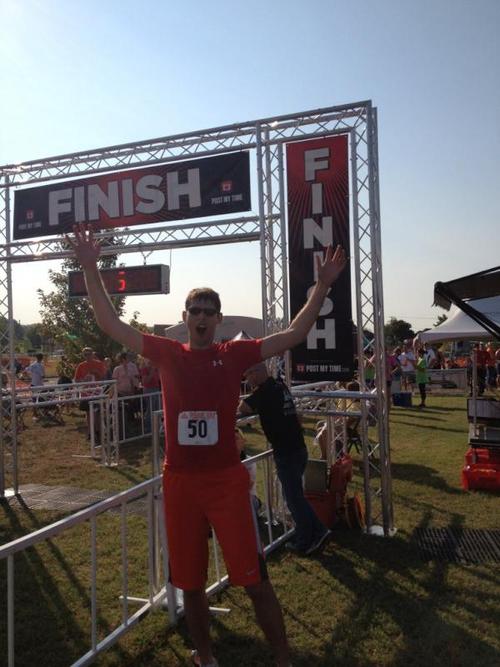
I finished a sprint tri in Republic, MO.

Back in May, I started looking for a race. I knew that with Stry.us happening, I had plenty of business goals for the summer. What I didn’t have was an athletic goal to work toward.

So I started looking for a race. The 5Ks all seemed to fall on weekends when I’d be traveling for business. There were a few half marathons or marathons around the Ozarks, but there was no way I was doing one of those.

Then I found one that could work: The Republic Tiger Tri, taking place just around the block from Stry.us HQ. The race seemed straightforward: 300 yard swim, 12 mile bike, 5K run.

I signed up before I had a chance to convince myself that it was too crazy to do.

I spent the summer training. I did lots of running, lots of biking, and a weekly swim at the Republic pool. I did stuff I’d never done before: Kickboxing, intense weightlifting. Starting in July, I cut out beer and most sweets.

On Friday, when I picked up my race packet, I’ll admit that I was a little scared. Then I drove the bike course.

And I was a lot scared. Who knew the Ozarks had hills like these?

But I kept telling myself: You finish what you start, Dan. You signed up for a sprint triathlon. You thought this was gonna be easy?

I woke up at 5 on Saturday morning. I had everything packed in advance. I drove up to the race course. I got everything laid out in the transition area. The PA announcer called everyone to the pool.

And then I looked at my stuff, and I realized I was missing something:

A bike helmet.

There were 400 people competing in this thing, and I was the only one dumb enough to forget a bike helmet.

But I didn’t panic. Hell, I’m the guy who’s written a blog series called “The Things I Think About When Every Fucking Thing Goes Wrong.” I called Sarah, one of my reporters. I talked to the volunteer in the parking lot and one of the volunteers at the finish line. We coordinated a plan. Sarah would bring the bike helmet up to the course, and the volunteers would get it to my bike. It would be there waiting for me when I got out of the water.

Problem solved.

I grabbed my goggles and started to run up to the pool. They’d be putting in swimmers one at a time, and I’d be in the middle of the pack. I had a bit of time before I started the swim.

And then my goggles exploded.

Maybe exploded isn’t the right word. Disintegrated might be more appropriate.

I was running up to the pool, holding my goggles in my right hand, and the strap just snapped.

I was left holding the lenses and nothing else.

Oh, hell.

But that’s alright, I told myself. You finish what you start. And I’m the guy who believes that the harder the journey, the better the reward.

I found a volunteer, and she found the head lifeguard at the pool. I just need something functional to swim in, I told him. I’ll swim in a snorkel mask if I have to.

He did me one better: He found an extra pair of goggles from another lifeguard.

Second problem solved.

I got myself in line, right in the middle of a group that expected to swim the 300 yards in 6:30. I started talking to the guy in front of me. He was telling me about how he’d run a marathon last year in Fayetteville, Ark. — at an 8:20 pace!

I was blown away. I wish I could run like that, I told him. Of course, I said, you’re a bit lighter than me.

He weighed about 140 pounds.

That’s not quite true, he told me. Two years ago this month, he weighed 255 pounds. He went to the fair in Springfield with his daughter, and the fair wouldn’t let him on the rides. He was too fat.

He’d had enough, he said.

So one step at a time, one day at a time, he started working it off. He gave himself big goals. Hit 200 and he’d buy a pickup truck. Go lower and he’d try a big race.

He’s now the owner of a new truck. He’s run a marathon. They let him on the rides at the fair. He doesn’t have to worry about being the “fat dad” at school anymore.

Suddenly, listening to his story, all the chaos of my morning got a lot less complicated. His story put everything in perspective for me.

He’d had to change his life to get here. I’d put in the work this summer — but nothing quite like that.

I had no excuses. I just had to finish what I’d started four months earlier.

I finished my sprint tri on Saturday in 1:26:56 — and I brought it home with a 27:10 5K. I nailed the swim. I conquered the bike, and all those hills I was terrified of the day before.

And when I hit that run, everything hurt. I started feeling muscles in my legs that I didn’t know I had.

For the run, I turned to one final source of inspiration. I thought about what my sister had told me on Friday. She’s run a couple of half marathons. She’s one of the toughest people I know.

A race like this is 90 percent mental, she’d told me. Just keep putting one foot in front of the other. Eventually, all those little steps will take you somewhere.

So I took her advice. I pushed hard through the run. I kept my head up and my feet moving.

And damn if it didn’t feel good when I crossed that finish line and had the race official hand me my time. Damn if it didn’t feel good to see Sarah running up to give me a giant hug, her yelling out, “I can’t believe you just did that! I can’t believe you just did that!”

Damn if it doesn’t feel good to be able to say now: I finished what I started.
The Magic Equation: Work = Passion + Hustle + Skills + Time + Tribe.

Let it be known: I love doing the work.

I love it. I love showing up each day to make things happen. I love the feeling at the end of the day when I know I’ve done good work.

But when I talk about “the work,” I’m not talking about the day-to-day tasks and duties. I’m not talking about the bullet points.

The work is so much bigger than that. What I’m talking about is The Work — the thing you do to make a dent in this universe.

The work starts with five things. It is a simple equation:

Work = Passion + Hustle + Skills + Time + Tribe

Some people have one, maybe two of those things down. A lot of entrepreneurs have the first three, but they don’t have the time or the tribe, and without those, projects die.

If you can find a way to put all five together together, you’ll have magic.

Passion

Do you love showing up to put in the hours? Are you excited about what you do? Do you truly care?

Matt Rutherford’s a case study in passion. This year, he circumnavigated the Americas on a 27-foot sailboat — by himself, without stopping. A fellow sailor who’d done the journey — on a much larger boat, and with a small crew — described Rutherford like this:

“What Matt is trying to do, I’m absolutely blown away by it, He’s doing this in a boat that, frankly, I’d be scared to sail from Newport to Bermuda. I’m in awe of the guy. This is such a mammoth undertaking, and to do it without stopping — alone — is mind-boggling. It’s almost teetering on the edge of blood-insanity, frankly.”

That’s the kind of passion I’m talking about: the kind of passion that would drive your fellow colleagues to question your own sanity. Great work will push you to limits others say can’t be reached. Without crazy passion, you’ll listen to them — and turn back before the journey’s up.

Love — with every bit of you — what you do. It’s the only way to convince yourself to do what should be impossible.

Hustle

Hustle often gets confused with speed, and that’s not quite right. Hustle isn’t about working faster. It’s about working harder. It’s about putting in those extra hours, and making a few extra things happen each day.

Hustle means setting your alarm clock 15 minutes earlier every morning to make time for a big task. It means staying at the office 15 minutes later to make that extra call. Over the course of the year, all those 15 minutes add up.

The Olympics have given us story after story of athletes who hustle: the soccer player who has a bad game and then turns in 10 straight days of four-hour work sessions to prove to her coach that she’s ready for the Games; the gymnast who takes an extra job as a teenager so can he support his family while he works towards London.

Hustle is one of the true game-changers in this world. Hustle is the physical manifestation of passion. It’s the way you show how hard you’re willing to go to do work you love.

Skills

What skills do you already have? And what do you need to learn in order to do better work?

The greats go and practice their skills every day, and they get better. Over time, skills get honed, refined and perfected.

Skills can be learned. You have no excuse: To do great work, you must make learning a priority.

If you’re not constantly evaluating your own skills, you’re not thinking about what you can do to do better work.

Time

Time cannot be accrued; it can only be lost.

So do you have time to do the work you need to do? There’s a reason many of the greats preach the virtues of saying “no” to time-consuming requests. There’s a reason the greats say something like this nearly every day:

But we can’t. We get the time we have. And every day is one less day.

Great work requires all the time you have. Start immediately.

Tribe

The final piece of the work, and the least obvious. Your tribe encompasses the people who believe in you and support you. They are your friends, your family, your co-workers, your mentors. They are the people who love the work you do.

Everyone who does great work has a tribe. Together, with your work and their support, you can make things happen that you alone cannot do. Work is best shared.

But you must be willing to ask for help, and you need that tribe there to help you find the answers.

Find your tribe and show them how important they are to you. They will give it back to you ten-fold.

¶ ¶ 

So that’s your equation: Passion + Hustle + Skills + Time + Tribe. Put those five together and — I promise you — you will do great work. Some of it will break through, and some of it will not. Luck and timing will play a role.

But if you have those five things, you have the formula.

Now it’s up to you to make the work happen.

Today, I urge you: Do great work.

That photo of the work getting done comes from @pyensan.

Big Auto’s Failures Can Teach Us A Ton About Building A Better Future For News.

“You can’t build a reputation on what you are going to do.” ― Henry Ford

 
In the late 1880s, Karl Benz built the first modern automobile. In 1908, the first Model T rolled off the assembly line.

And then came the dawn of a new age in America: The age of the automobile.

You know this part of the story.

When most people talk about the birth of the American auto movement, they talk about companies like Ford and Oldsmobile. They talk about the handful of companies that broke through and got their cars into driveways across America.

But they leave out names like Auto-Bug and Biddle and Vulcan, three of the 2,000-some car companies founded in America that have since closed their doors.

2,000 companies entered this space, and today, we’re left with about 15.

This is how it often works at the start of a big movement. In the wake of a breakthrough invention, there’s a rush of people who enter the field to offer up a product. Some survive; most don’t.

And new competitors enter the field, too. Henry Ford wasn’t thinking about skateboards or bikes or subways or buses or helicopters when he built the Model T, but today, they’re all players in the field of transportation.

The point is, at the start, it’s chaos. Over time, chaos weeds out much of the competition. Some companies innovate, but far more die off.

Out of many, few.

So here’s what it means for news:

Right now, we have the web. We’re still not sure how to make this thing work. But we’ve got lots and lots of people entering the field.

We know that what we’re doing really isn’t sustainable. We have readers; what we want are paying customers and partners.

But what I want right now is more competition. I want more people entering the field. I want more people bringing great ideas to the table.

Like Clay Shirky said: Nothing will work, but everything might.

We need more doers. We need more action. Most of us will fail, but that’s alright. It’s entirely possible — maybe even probable — that Stry.us will go the way of the Auto-Bug or the Biddle, just another company forgotten in time.

But in order to build a better future for storytelling, we have to actually do things. I so admire the 2,000 founders behind those initial car companies. They had the right idea, just the wrong luck or team or execution.

But they made something happen. I hope my colleagues in news don’t give in to the inevitability that many of us are going to die off, and that we’ll be left with a few big media conglomerates running the show.

We have to build. We have to create. We have to do.

The rush to build a better story is just beginning. This is no time to idle.

Image of the Model T at top via @erinslomski.

The Night I Got My Mojo Back.

Photo of the D.C. Metro via @orettedaredaro

At this point in my life, I’m still learning how to produce good work. The quality of the work will change over time, but everything I do starts with a commitment to work.

That work ethic started about the 1st of this year, actually. That’s when the schedule I have today — the hours, the projects, the shipping — really began.

But the attitude behind this work ethic goes back a little further than that, actually.

It started with, of all things, a kiss.

I had gone out for dinner with a friend of a friend. This was about 18 months ago. She was working on a cool project, and we wanted to trade ideas about it. Dinner led to drinks. Drinks led to more drinks. Our dinner get-together moved into its fourth hour, than its fifth.

Sometime past midnight, we decided to call it a night. I wanted to ask her out. I needed to ask her out. I had only been in D.C. for a few months. Stry.us was losing momentum. I had just sent in an application for this fellowship I’d heard about at RJI. I was living in my childhood bedroom.

I really needed a win.

And then this amazing little night happened, and I was so giddy. I had to see her again.

I asked her out on the escalator down to the Metro. She said yes. Then she quickly said goodnight. She took another escalator down to her subway track. I walked towards my train.

The electronic signs said the Metro wouldn’t come for nine minutes.

Nine minutes.

Nine minutes to think about what had just happened. Nine minutes to work through the evening.

Nine minutes to beat myself up over the fact that I should’ve kissed her. I had really wanted to kiss her. You should’ve done it, Dan.

And then a part of me realized something that I’ve carried with me to this day: The fear of not taking action far outweighed the fear of taking action. The fear of having to sit on that platform for nine minutes and think about missing that opportunity was much more powerful than the fear of making a move (and maybe looking dumb in the process).

That feeling’s stuck with me. I know that I have amazing opportunities before me, as I try to build a better future for reporting and storytelling and community. I cannot let days just slide by. Motion matters. Action matters.

I got mad that night. I got mad at myself for being unwilling to do what I wanted. I got mad at myself for not chasing my curiosity.

I went down the escalator. I started looking for her. There were a few hundred people on that platform — some drunk, some tired, all unhappy to be waiting. She was down at the end of the platform.

I had something to say, and it kind of came out mumbled. But she smiled. I leaned in. We kissed.

Then I bolted. I was way too giddy to make small talk after that.

The relationship lasted a few months before it fizzled out. But I’ll always remember that first kiss. It reminds me not to idle, not to worry, not to regret.

It reminds me that amazing things happen in unexpected places, and that boldness and action matter.

We always complain about how little time we have. But I like to remind myself: Dan, do you remember how much time you wasted before you started?

There is no longer time to idle. There is only time for action.