The Magic Equation: Work = Passion + Hustle + Skills + Time + Tribe.

Let it be known: I love doing the work.

I love it. I love showing up each day to make things happen. I love the feeling at the end of the day when I know I’ve done good work.

But when I talk about “the work,” I’m not talking about the day-to-day tasks and duties. I’m not talking about the bullet points.

The work is so much bigger than that. What I’m talking about is The Work — the thing you do to make a dent in this universe.

The work starts with five things. It is a simple equation:

Work = Passion + Hustle + Skills + Time + Tribe

Some people have one, maybe two of those things down. A lot of entrepreneurs have the first three, but they don’t have the time or the tribe, and without those, projects die.

If you can find a way to put all five together together, you’ll have magic.

Passion

Do you love showing up to put in the hours? Are you excited about what you do? Do you truly care?

Matt Rutherford’s a case study in passion. This year, he circumnavigated the Americas on a 27-foot sailboat — by himself, without stopping. A fellow sailor who’d done the journey — on a much larger boat, and with a small crew — described Rutherford like this:

“What Matt is trying to do, I’m absolutely blown away by it, He’s doing this in a boat that, frankly, I’d be scared to sail from Newport to Bermuda. I’m in awe of the guy. This is such a mammoth undertaking, and to do it without stopping — alone — is mind-boggling. It’s almost teetering on the edge of blood-insanity, frankly.”

That’s the kind of passion I’m talking about: the kind of passion that would drive your fellow colleagues to question your own sanity. Great work will push you to limits others say can’t be reached. Without crazy passion, you’ll listen to them — and turn back before the journey’s up.

Love — with every bit of you — what you do. It’s the only way to convince yourself to do what should be impossible.

Hustle

Hustle often gets confused with speed, and that’s not quite right. Hustle isn’t about working faster. It’s about working harder. It’s about putting in those extra hours, and making a few extra things happen each day.

Hustle means setting your alarm clock 15 minutes earlier every morning to make time for a big task. It means staying at the office 15 minutes later to make that extra call. Over the course of the year, all those 15 minutes add up.

The Olympics have given us story after story of athletes who hustle: the soccer player who has a bad game and then turns in 10 straight days of four-hour work sessions to prove to her coach that she’s ready for the Games; the gymnast who takes an extra job as a teenager so can he support his family while he works towards London.

Hustle is one of the true game-changers in this world. Hustle is the physical manifestation of passion. It’s the way you show how hard you’re willing to go to do work you love.

Skills

What skills do you already have? And what do you need to learn in order to do better work?

The greats go and practice their skills every day, and they get better. Over time, skills get honed, refined and perfected.

Skills can be learned. You have no excuse: To do great work, you must make learning a priority.

If you’re not constantly evaluating your own skills, you’re not thinking about what you can do to do better work.

Time

Time cannot be accrued; it can only be lost.

So do you have time to do the work you need to do? There’s a reason many of the greats preach the virtues of saying “no” to time-consuming requests. There’s a reason the greats say something like this nearly every day:

But we can’t. We get the time we have. And every day is one less day.

Great work requires all the time you have. Start immediately.

Tribe

The final piece of the work, and the least obvious. Your tribe encompasses the people who believe in you and support you. They are your friends, your family, your co-workers, your mentors. They are the people who love the work you do.

Everyone who does great work has a tribe. Together, with your work and their support, you can make things happen that you alone cannot do. Work is best shared.

But you must be willing to ask for help, and you need that tribe there to help you find the answers.

Find your tribe and show them how important they are to you. They will give it back to you ten-fold.

¶ ¶ 

So that’s your equation: Passion + Hustle + Skills + Time + Tribe. Put those five together and — I promise you — you will do great work. Some of it will break through, and some of it will not. Luck and timing will play a role.

But if you have those five things, you have the formula.

Now it’s up to you to make the work happen.

Today, I urge you: Do great work.

That photo of the work getting done comes from @pyensan.

Big Auto’s Failures Can Teach Us A Ton About Building A Better Future For News.

“You can’t build a reputation on what you are going to do.” ― Henry Ford

 
In the late 1880s, Karl Benz built the first modern automobile. In 1908, the first Model T rolled off the assembly line.

And then came the dawn of a new age in America: The age of the automobile.

You know this part of the story.

When most people talk about the birth of the American auto movement, they talk about companies like Ford and Oldsmobile. They talk about the handful of companies that broke through and got their cars into driveways across America.

But they leave out names like Auto-Bug and Biddle and Vulcan, three of the 2,000-some car companies founded in America that have since closed their doors.

2,000 companies entered this space, and today, we’re left with about 15.

This is how it often works at the start of a big movement. In the wake of a breakthrough invention, there’s a rush of people who enter the field to offer up a product. Some survive; most don’t.

And new competitors enter the field, too. Henry Ford wasn’t thinking about skateboards or bikes or subways or buses or helicopters when he built the Model T, but today, they’re all players in the field of transportation.

The point is, at the start, it’s chaos. Over time, chaos weeds out much of the competition. Some companies innovate, but far more die off.

Out of many, few.

So here’s what it means for news:

Right now, we have the web. We’re still not sure how to make this thing work. But we’ve got lots and lots of people entering the field.

We know that what we’re doing really isn’t sustainable. We have readers; what we want are paying customers and partners.

But what I want right now is more competition. I want more people entering the field. I want more people bringing great ideas to the table.

Like Clay Shirky said: Nothing will work, but everything might.

We need more doers. We need more action. Most of us will fail, but that’s alright. It’s entirely possible — maybe even probable — that Stry.us will go the way of the Auto-Bug or the Biddle, just another company forgotten in time.

But in order to build a better future for storytelling, we have to actually do things. I so admire the 2,000 founders behind those initial car companies. They had the right idea, just the wrong luck or team or execution.

But they made something happen. I hope my colleagues in news don’t give in to the inevitability that many of us are going to die off, and that we’ll be left with a few big media conglomerates running the show.

We have to build. We have to create. We have to do.

The rush to build a better story is just beginning. This is no time to idle.

Image of the Model T at top via @erinslomski.

The Night I Got My Mojo Back.

Photo of the D.C. Metro via @orettedaredaro

At this point in my life, I’m still learning how to produce good work. The quality of the work will change over time, but everything I do starts with a commitment to work.

That work ethic started about the 1st of this year, actually. That’s when the schedule I have today — the hours, the projects, the shipping — really began.

But the attitude behind this work ethic goes back a little further than that, actually.

It started with, of all things, a kiss.

I had gone out for dinner with a friend of a friend. This was about 18 months ago. She was working on a cool project, and we wanted to trade ideas about it. Dinner led to drinks. Drinks led to more drinks. Our dinner get-together moved into its fourth hour, than its fifth.

Sometime past midnight, we decided to call it a night. I wanted to ask her out. I needed to ask her out. I had only been in D.C. for a few months. Stry.us was losing momentum. I had just sent in an application for this fellowship I’d heard about at RJI. I was living in my childhood bedroom.

I really needed a win.

And then this amazing little night happened, and I was so giddy. I had to see her again.

I asked her out on the escalator down to the Metro. She said yes. Then she quickly said goodnight. She took another escalator down to her subway track. I walked towards my train.

The electronic signs said the Metro wouldn’t come for nine minutes.

Nine minutes.

Nine minutes to think about what had just happened. Nine minutes to work through the evening.

Nine minutes to beat myself up over the fact that I should’ve kissed her. I had really wanted to kiss her. You should’ve done it, Dan.

And then a part of me realized something that I’ve carried with me to this day: The fear of not taking action far outweighed the fear of taking action. The fear of having to sit on that platform for nine minutes and think about missing that opportunity was much more powerful than the fear of making a move (and maybe looking dumb in the process).

That feeling’s stuck with me. I know that I have amazing opportunities before me, as I try to build a better future for reporting and storytelling and community. I cannot let days just slide by. Motion matters. Action matters.

I got mad that night. I got mad at myself for being unwilling to do what I wanted. I got mad at myself for not chasing my curiosity.

I went down the escalator. I started looking for her. There were a few hundred people on that platform — some drunk, some tired, all unhappy to be waiting. She was down at the end of the platform.

I had something to say, and it kind of came out mumbled. But she smiled. I leaned in. We kissed.

Then I bolted. I was way too giddy to make small talk after that.

The relationship lasted a few months before it fizzled out. But I’ll always remember that first kiss. It reminds me not to idle, not to worry, not to regret.

It reminds me that amazing things happen in unexpected places, and that boldness and action matter.

We always complain about how little time we have. But I like to remind myself: Dan, do you remember how much time you wasted before you started?

There is no longer time to idle. There is only time for action.

To Be Or Not To Be? You’re Overthinking It. Just DO.

Two of my reporters came to me last week with an idea for Stry.us: We should use our Twitter feed to curate a bucket list of Springfield-related things, and then cross those things off as the summer goes on. It’d be a way to engage our audience and to learn more about our new city.

Great! I said. Let’s do it.

And wonderfully, my reporters didn’t freak out at this. They didn’t say, Hey, shouldn’t we talk about this some more? Shouldn’t we have another couple of meetings or something?

I hate meetings. And I hate overthinking, which is pretty much the in-your-head equivalent of a meeting. I hate any unproductive time spent thinking and debating instead of building or creating or doing.

There is certainly a time for contemplation, and there is a time for thought.

But I’d argue that the best time to think about action is after you’ve already started doing. Discussion about action that’s already happened/happening is so much more productive, because once the action begins, you start to learn what truly works.

Action leads to practical solutions. Discussion often merely leads to theory.

I’d take the former every single time.

I’ve wasted so much time talking about what I could do or should do or might do. But the only thing that matters is what I actually do.

So start. Start before you’re ready.

To be or not to be? Nah, that’s too much thinking. Just do.

There Is No Set Path From A->B. There Are Only Steps. Take The First One.

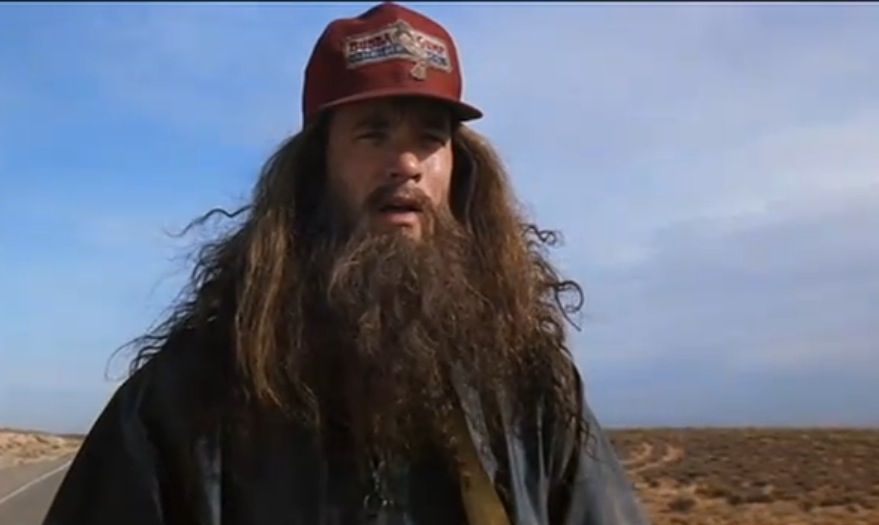
Run, Forrest, Run.

When I first started Stry.us, I had this notion that I was going to create a company that was going to disrupt the Associated Press. It was going to do a lot of things — most especially, it would tell great stories — but it would be funded by news organizations who would rip up their contracts with AP and give me their money instead. All I needed was 100 news organizations who’d give me $10,000 each.

This was the very definition of cluelessness.

I got excited, and I got ahead of myself. Way, WAY ahead of myself. It was going to take way more than three months of reporting from Biloxi for me to raise money for Stry.us.[1. And a million dollars! I thought I could get a million dollars! Lordy lordy was I dreaming big.]

The road from here to there — and for the record, the road has since changed, and I’m on a totally different path with Stry.us [2. And that’s totally okay!] — takes time. It takes a thousand tiny steps. There are no big leaps.

Think of it this way: Forrest Gump didn’t wake up and say, I’m going to run across the country four times.

No! He said: Maybe I’ll run down to the end of the block. And then to the end of town. And then to the end of the county.

And then you know what happens next:

My goal of getting people on board with Stry.us was one that was going to take time. It was going to take a certain amount of crazy before I got to that first follower, that first client.

It was going to take many tiny steps.

People quit too soon. If there’s one thing that I’ve done right, it’s that I haven’t quit on Stry.us. I’ve kept it going, and just by inching it forward, I’ve gotten it to Springfield.

It takes a thousand small steps to get to where you want to go. The first steps are slow. They are painful.

But if you really want to get somewhere good, you have to take the first one.

How You Hug Is How You Do Everything In This World.

I am a large human, and as a large human, I tend to give out really big hugs. They come in many forms: Bear hugs, bro hugs and — best of all — lift-you-off-the-ground-and-swing-you-around hugs.

I have a friend who loves the latter type of hugs almost as much as I do. She’s amazing in every sense of the word. When we go to concerts, she’s the one dancing as though nobody else is watching. When she was at college, she was an athlete, and the football team bought this new accelerometer machine to measure how much impact a defensive lineman could make on impact. She was the only female athlete crazy enough to line up opposite this machine and run full speed at it.[1. She almost dislocated her shoulder in the process.]

And her hugs — oh, the hugs! When she hugs, she does so arms extended, feet completely leaving the ground. She does not hug as much as she leaps into your waiting arms.

This is how she does everything.

It’s really an incredible way to face the challenges of this life. Embrace the world — and all its magic — with everything you have. Leave nothing behind.

Jump into the things you love best, and know that when you need it most, you’ll find amazing people waiting there to catch you.

Thanks to Instagram user @jimmyjoephoto for the amazing photo at top.

Why ‘Just Be Yourself’ Is Lousy Advice When You’re Young.

Here’s a piece of advice I don’t much care for, especially when it’s directed towards young people: Just be yourself.

You’re giving a talk? Just be yourself.
You’re writing a paper? Just be yourself.
You’re going on a date with Cindy Crawford? Just be yourself.

But the problem is, What if you’re not really sure who you are yet?

To the confused souls among us — and yeah, I’d put myself in that category some days — “Just be yourself” is lousy advice. Before you can be yourself, you have to find yourself.

That takes time. We find ourselves through trying new things, through experimenting, through stepping out beyond our boundaries and seeing what we like and what we don’t.

And we never really stop searching for who we are. There will come a time when you find a version of yourself that you really like. That’s fantastic.

But it’s only the 1.0 version. You cant stop there. You can’t stop growing. You can’t stop trying new things.

I’d like to do away with “just be yourself.” I’d rather tell someone, “Do something that scares you.” Action leads to discovery.

Don’t settle for being someone you’re not totally sure of. Do the work, and through that, you’ll find yourself.

My Little Brother is Lazy. But What I Can Really Do About It?

Sam O

My little brother is — and I say this with all the love that I can muster — the laziest little shit I know.

I just got off the phone with my mother. She told me that ever since he got back from college, he’s been sleeping in until 2 p.m. every day. She wants to get him tested for mono. She thinks something’s wrong with him.

There’s nothing wrong with him. He’s just 19 years old, and the only difference between him and Garfield the cat is that Garfield sometimes makes his bed.

Sam O, despite that laziness, actually pulled off an amazing internship this summer. It starts Monday. He’s also got a dream job in mind, and that company has offered him the opportunity to do some volunteer work on weekends.

Whether or not Sam O takes advantage of any of this is really up to him.

There’s something I’ve learned over the years, and it’s that no matter the situation, there’s only one way you can really learn something:

Your own way.

You cannot be told to do something. Comments from friends and strangers can spark something in your head, but the only action comes when you decide to take it.

And often, that action only comes when you’ve hit bottom.

I hope Sam O takes advantage of his opportunities this summer. I hope he works hard. I hope he changes his sleeping habits. I hope he decides to get off his lazy ass and join a gym.

I hope all of these things for Sam, but I know that no number of calls or texts or emails will change his habits.

He will do what he wants to do. He will learn when he wants to learn.

It is his road, and the best I can do is to support him and hope that he learns sooner rather than later.

A Dan Oshinsky Birthday Wish: Today, Do Something That Scares You.

It's my birthday? It's my birthday.

Today is my birthday. I haven’t wished for something on my birthday in a long time, but hell, I’m 25, and I’m feeling old. So here’s my wish.

This wish is for you.

Today, I wish that you’ll read this and do something that scares you. You’ll say something out loud that you’ve been afraid to say. You’ll try something that you’ve been afraid to try. You’ll do something a little bit crazy.

On this 25th birthday of mine, I feel so, so very lucky to have the chance to work on Stry.us. This thing scares the absolute crap out of me, but it’s a joy to wake up with that fear. It keeps me going.

I beg you today to experience some of that fear. Please: Go do something that scares you. A little thing or a big thing — it doesn’t matter what it is.

But every good thing in this world starts with action. Forget the fear. Today, you have my birthday permission to ignore it and try something insane.

Today: Do something.

That’s my birthday wish.

The ‘Cool Runnings’ Theory of Doing the Work.

I’m going to guess that you’ve seen the movie “Cool Runnings,” simply because I’ve never met anyone who hasn’t seen “Cool Runnings.” It’s one of my favorite films, the based-on-a-true-story tale of four Jamaican guys who somehow qualify for the Olympics as bobsledders. It’s funny, and goofy, and inspiring.

It’s also, it turns out, a really interesting case study in learning how to start doing the work.

Think about the beginning of the movie. We meet our four intrepid bobsledders in unlikely places: Three are trying to qualify for the Summer Olympics in track, and one is a pushcart driver. But when the track thing doesn’t work out, they come together to try to qualify for the Olympics in bobsled, even though they’ve never seen snow, and the Olympics is only a few months away.

And somehow, they qualify for the Games. These four men — through sheer willpower, and also a few classic Disney montages — put in the work needed to learn how to bobsled, and they make the Olympics.

But on the first night of the Games, disaster strikes. They can’t get into the sled fast enough, and the driver, Derice Bannock, has a bad race, and Jamaica finishes the day in last place among all teams.

Then comes the key scene. The whole team is back in their room in the Olympic Village. Derice and his coach, Irv, are talking about what went wrong. Derice suggests that maybe they don’t know enough about the race course. Maybe they don’t know about bobsledding to win.

And that’s when their coach says:

“You know the turns! You know everything there is to know about this sport!”

Think about that for a second, and strip away the fact that this is a Disney movie. Imagine it by itself: An Olympic-caliber coach telling his team, You know everything there is know about the sport, even though you just started learning about it a few months earlier.

That sounds outrageous, and it is. Of course they don’t know everything about the sport! Hell, it’s not even clear that a single member of the team could name someone besides their coach who’d ever competed in an Olympic bobsled event.

But what if I told you that their coach was right? What if I told you that they knew everything they needed to know? — to start, at least.

What do you really need to compete in a four-man bobsled race?

1. A sled
2. A bobsled track
3. Four really big, really strong, really fast men
4. Four helmets
5. Ice

And that’s it. You don’t need fifteen years of bobsled experience to start. You don’t need to know who won the four-man event in the 1984 Sarajevo Winter Games.

All you need is a sled, and a track, and four dudes, and some helmets, and some ice, and you can start racing.

Again, here’s the key concept: That’s what you need to start racing.

Yeah, to win a gold medal, it’s going to take years and years of practice. It’s going to take thousands of hours of work, and then some luck, and Jamaica wasn’t even close to having enough practical experience to win.

But to start, they had everything they need to know.

That’s the idea I want to drill into your heads. If you’re thinking about becoming the world’s best painter, well, yes, it’s going to take some time. You’re going to have spend a lot of time painting, and you’re probably going to spend a lot of time studying other painters.

But to start? All you need is a brush, a canvas, some paint and a little free time.

The world’s best basketball players all started with a ball, sneakers and a court. You think Michael Jordan waited until he’d watched a decade of basketball games before he felt he had enough basketball knowledge to pick up a ball?

Hell no.

The truth is, to start, you don’t need to know all that much. So start before you’re ready, because as Travis Robertson once wrote, you won’t feel ready until long after you’ve already started.

Let me give you another example. I was at a startup event in the fall and heard a guy pitch a lending business. He talked about how he’s been studying the field for five years, reading everything he can about lending, and he’d finally decided that he was ready to start.

The judges asked him what he’d actually done for his business idea in those five years.

Well, he said, I’ve read the books, and I’ve…

No, no, the judges said. What have you done? What actual work do you have to show us?

Nothing, he said.

And where do you think you’d be if, five years ago, you’d started building something instead of just thinking about it?, the judges asked.

The man’s face went blank.

You don’t need to know that much to start. You just need to know that you can do the work, and that you’re passionate about doing the work.

You need to start before you’re really ready to start, because that’s when you’re going to learn the most about what you’re doing. What you’ll read about in books is helpful, and important, but it’s nothing compared to the self-discoveries you’ll make along the way. The most important knowledge is what you’re going to learn during the process of the doing.

If you already know what you want to do, then ask yourself: What are the most basic tools I need to start?

If you have them already, then the only thing truly keeping you from starting is you.