Showing Your Work.

Catci, trees, and other plans grow alongside a walking path.

We took a visit to St. George, Utah, last weekend. And up on the hills above the city, there’s this little desert oasis called Red Hills Desert Garden.

Inside, there are walking paths and a little stream. You can cross over the stream on these beautiful red rocks, and walk along red clay paths to see spots where dinosaurs once roamed. You can see all sorts of desert landscaping, too. It’s quite beautiful, really.

And most interestingly: The entire thing is run not by the local parks department but by the Washington County Water Conservancy District.

Once I realized that, I started to notice that there were little signs everywhere talking about how to save water. In St. George, the average annual rainfall is about eight inches, and the county has made a push to encourage people to replace their lawns with desert landscaping. And as part of that push, they created this garden where locals can see just how beautiful their homes could be if they planted cacti or desert-friendly plants instead of grass in their yards.

They even host regular events and classes there, highlighting ways to conserve water and create a beautiful desert landscape on a budget.

Instead of just telling people that they should plant things that don’t use up lots of water, they created an entire garden as a showcase for this type of landscaping. It’s part-garden, part-showroom.

I love that they showed their work — and know that once you see what you can do with desert landscaping, others will choose to bring those ideas back to their own homes.

———

I took that photo at Red Hills Desert Garden. Even on a cloudy day, the garden was still lovely to walk through.

Did You Ask the Right Question?

We just finished watching the second season of “Nobody Wants This.” The first season was great, and I didn’t think the second season quite lived up to the first. I love the cast, and there were a lot of great moments. So what was missing from season two?

To me, the first season worked because the story arc was built off of a big question: Can these two characters (played by Kristen Bell and Adam Brody) make it? It worked as a hook and kept us interested throughout the season. I wanted to know how they’d answer that question.

But the second season’s question (“Will Kristen Bell’s character convert to Judaism?”) didn’t resonate with me in the same way — I just didn’t really care either way — and it affected the rest of the season. Without the big arc, it’s tough to stay invested in a show in the long run.

Had they been asking a different question, my reaction to the season is probably a lot different. (Weirdly, rewatching the trailer, I think they got the big question right there! It just didn’t quite come through in the actual show.)

I see versions of this in my work. I’ll talk with people who’ve built what looks to be a great newsletter — the design is good, they’ve put a lot of work into the content — but they’re not asking the right question. They don’t really understand what their audience wants — or maybe even who their audience is — and as a result, the newsletter doesn’t have clear value.

So when something falls flat, I try to steer back to those big questions. Who is this for? What do we do to serve them? And how do we clearly explain this value to them?

Getting back to those answers can help get the work back on track.

Find Your One Liner.

Pete Carroll signs a USC football helmet in 2010.

There was a wonderful story the other day from Ben Malcolmson, right-hand man for NFL head coach Pete Carroll, in which he wrote about finding your true identity. He told a story about a talk that Pete once gave:

During his talk that day, Pete asked the room: “How many people here have a philosophy for life or for work?”

Probably three-quarters of the room raised their hands. Then he asked: “How many people could tell me that philosophy in one line?” All but three or four arms bashfully went down. Pete called on one of the people who had kept their hand raised and had them share their philosophy in front of the whole room.

For the longest time, I’ve had a simple one: “Find the things you love and the people you love and make time for both.” Whenever I feel a little lost or uncertain, that one liner helps remind what I need to do to get back to a good place.

Malcolmson has some suggestions on how to find your one liner. It’s worth taking the time to try to find yours.

–––

That photo of Carroll was taken in 2010, when he was the head coach at USC. It was taken by Warwick’s Books, published on Flickr, and used here thanks to a Creative Commons license.

Kick Over Rocks.

I stumbled upon this story the other day about the CEO of Pittsburgh’s airport, Christina Cassotis. I’ve got a soft spot for Pittsburgh — my wife’s from there, we got married there, and about once a year, we fly through there to visit my mother-in-law. The Pittsburgh airport’s a bit dated. It was built to be a hub for US Airways, but now that airline no longer exists, and the airport they have doesn’t really fit with what the city needs.

So I was fascinated to read this story in Pittsburgh Magazine about Cassotis, an executive who, by all accounts, is doing great things to rebuild and modernize the airport. (The rebuild of the airport will cost $1.7 billion, per one account.)

This was my favorite section from that Pittsburgh Magazine article:

“You don’t know how things work around here,” someone yelled after she instituted Uber pickup at the airport soon after she was hired. “Who do you think you are? You think you just come in here and change things?”

“Yeah, I actually do,” Cassotis replied. “That’s my job. My job is literally to kick over rocks. We have to do things differently if we’re going to get different results.”

I absolutely love that mentality. Sometimes, you need leaders who can guide you through a series of slow, steady changes. Sometimes, you need a leader who can recognize when things have been broken for a long time and really roll up their sleeves.

Never be afraid to kick over those rocks.

———

That’s a photo I took at Pittsburgh International Airport back in 2019. When you’re walking to the train to take you to baggage claim, you used to have to walk past two statues of legendary figures in western Pennsylvania history. One is George Washington. The other is former Steeler Franco Harris. I always loved that in Pittsburgh, these two men were given statues right next to each other, and no one seemed to think it was odd that our nation’s first President and a guy who played fullback in the NFL were given equal weight.

Roll With It.

It’s Wednesday morning, about 7:20 a.m. Central time. I’m in row 13 of a flight from Chicago back home to Salt Lake City. I don’t love flying that early in the morning, but I’ve got calls later that morning and then a kiddo to pick up in the afternoon. The early flight makes the most sense. I’ve checked the stats, too — in the past 60 days, this flight’s been early or on time nearly 90% of the time. We’re all set for an on-time departure, and my flight tracker app says we’ll arrive 20 minutes early, with plenty of time to make it home for the first call.

Which is exactly what does not happen.

There’s a plane stuck behind us at O’Hare, and it doesn’t move for about 40 minutes. Instead of an on-time departure, we end up with a very-not-on-time departure. I land in Salt Lake with just enough time to know that I won’t have enough time to make it home for the calls.

There would’ve been a moment when this would’ve really upset me and probably screwed up my day. But I’ve been through stuff like this before.

So I find a gate where the plane is just about to depart — it’ll be empty for an hour or two — and set up there. I take my calls. I apologize to my clients for talking to them from an unusual spot. No one really seems to mind. When the calls are over, I get a Lyft to take me home.

Things happen. It’s up to you to roll with the changes.

———

I took that selfie at the gate just before my flight. Was I tired? Sure. Would I have been happier taking the call at home? Absolutely. But things happen.

Enjoy Where You Are.

Lots of white snow — and mountainous peaks behind — at Alta Ski Resort.

We went skiing at Alta today. Alta is a special place. You’re up in the mountains, a 20-minute drive away from anywhere. From the top, you won’t see homes or hotels or any sort of city — just snow and trees and mountains — and the skiing is fantastic.

We rode up one chair with someone from Pittsburgh, and we asked him if he did a lot of skiing back east. “Oh, tons,” he said, before listing off the mountains he’ll ski within a few hours of his home. Some of the mountains he mentioned are tiny, one-chairlift kind of mountains. But he said he loved skiing them just as much as he enjoyed skiing out west.

“Any day I have my ski boots on is a good day,” he said.

It’s such a wonderful sentiment, and it really stuck with me throughout the day. I grew up skiing tiny mountains in Maryland and Pennsylvania, and now I’m lucky to live just minutes from world-class ski resorts. I’m not going to try to convince anyone that the quality of skiing is as good at Whitetail as it is at Deer Valley — it isn’t.

But that doesn’t mean you can’t enjoy those mountains. I’ve had amazing days skiing at tiny resorts. 

The conversation on the chairlift today was a reminder that no matter what you’re doing, you can make the most of the experience. It’s up to you to stay in the moment and to find the little things that make that experience special.

———

I took that photo while riding up the Sugarloaf chair at Alta today. Tough to complain about blue skies and plenty of snow — in April!

You Ain’t Hamlet.

This interview with Jason Alexander, of “Seinfeld” fame, popped up in my feed the other day, and I think it’s worth watching in full. In it, he says:

I went to Boston University as a theater major, and because William Shatner was my muse, I wanted a dramatic career. I really thought I was going to play some of the great classical roles and be a dramatic actor. Sure, I hadn’t done much comedy. I’d done some musicals, so there was that, but I hadn’t done much comedy. And the summer second semester of my sophomore year, I had a professor named James Spruill at Boston. He was the only black member of the faculty. He was a guy who had come up in the ‘60s with street theater — theater is to change the minds of the masses, affect change. He brought me into his office for my my semester consultation, and he had this great basso kind of James Earl Jones voice, and he sat back, and he just kind of nodded his head and looked at me for a minute. He went, “I know that your heart and soul is Hamlet, and you would be a profound Hamlet. You will never play Hamlet, so you best get good at Falstaff.”

And he basically said, look, look in the mirror. You are 5’6’’. You are 20 to 25 pounds overweight, and you are losing your hair. You have a large performing persona. If you want a a commercially successful career, you’re going to be a comedian, and you’re not embracing it, you’re not looking at it, you’re not doing it.

Had he not said to me, “You ain’t Hamlet, man,” I would have finished that school and gone into the professional world thinking, ”Here’s Jason Alexander and the Iceman cometh. It’s what everybody is waiting for.”

And I would have been wrong.

It’s such a wonderful reminder: We all need someone in our lives who’ll be truly honest with us. Sometimes, we need that person to lift us up. Sometimes, we need them to keep on the right path. But all we need those voices we can trust, and if you find someone who can do that, you owe it to yourself to listen to them. They’ve got something worth hearing, even if it’s not what you want to hear at that moment.

Be Excellent, Not Perfect.

My Missouri Tigers had a huge win this past week in men’s basketball, and I went back to watch the highlight package that the basketball team put together. Mizzou’s coach, Dennis Gates, has a bunch of different sayings he uses. (For instance, his eight core values for success: “Friendship, love, accountability, trust, discipline, unselfishness, enthusiasm, and toughness.”)

But watching the movie, I heard one line I’d never heard before.

Gates: Communication has to be excellent, OK? It has to be excellent. It don’t have to be perfect, it has to be what?

Team: Excellent!

I’ve written a lot — like, so many different things — about perfection. But I love the idea of reframing the concept. For most of us, the goal shouldn’t be around perfection. The goal should be to put in the work, to enjoy doing the work, and to try to do something great.

Aim for perfection and you’ll usually fall short. Aim for excellence and you have a chance to do excellent work along the way.

Find Your Rubber Duck.

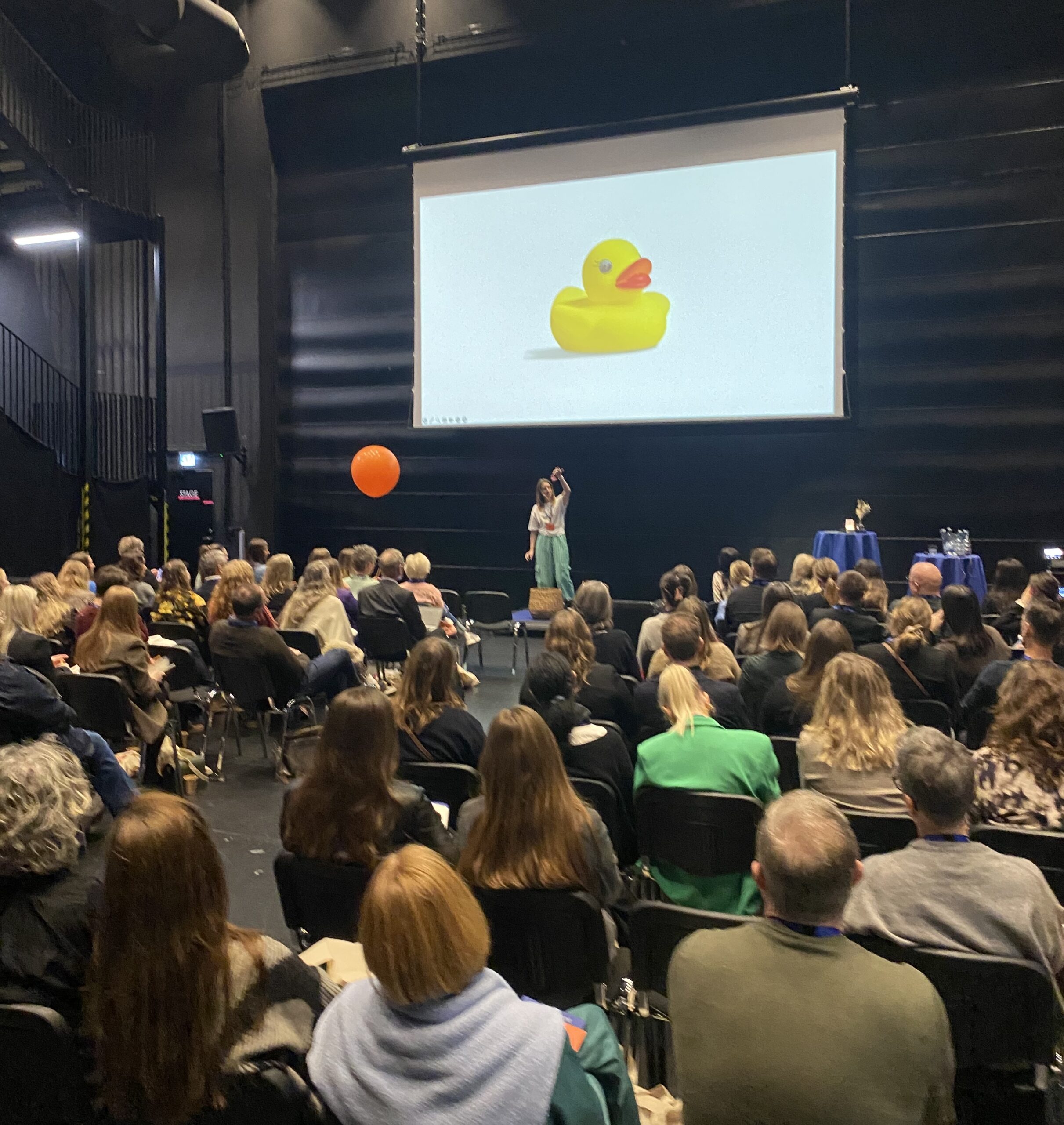
A few days ago, I saw Sandie Taulo Essemann do one of the smartest things I’ve ever seen a speaker do on stage.

So we’re in Odense, Denmark, for Email Summit. When I give talks in America, there’s usually a line of people coming up to ask follow-up questions or say hi. But in Denmark, the cultural tendency is to leave the speakers alone — they don’t want to bother the speaker, so they quietly shuffle out of the room.

I was talking to Sandie about this the night before the conference, and she said she’d figured out a way to get people to come up and chat with her afterwards.

“How?” I asked.

“I brought rubber ducks,” she told me.

In her suitcase, she explained, she’d brought more than 100 rubber ducks. She told me she planned to close the talk by reminding people that when they went back to work, she didn’t want them to lose the feeling of excitement that they had at the conference. She wanted them to take a rubber duck, put it on their desk, and use it as a reminder of the sense of possibility they’d felt at Email Summit. Anytime they felt like they weren’t making progress, the rubber duck would be there to remind them that they could always make things a little bit better.

So the day of the conference, I stood in the back as Sandie closed her talk with the story about the rubber duck. (Fun fact: There’s no word in Danish for rubber duck. They just use the English words.)

I’ve spoken in Denmark three times, and at this point, I’ve seen lots of speakers give talks, both in Danish and English, but I’ve never seen more than two our three people ever go up to the speaker afterwards.

And then I watched, with amazement, as Sandie finished the talk, and more than 100 Danes stood in line to say hi to her, ask her questions, and take home their very own rubber duck. (And I saw a ton of people scanning a QR code to sign up for her newsletter. These are people who didn’t just get a free rubber duck — they’re also going to become Sandie’s fans, and maybe even clients one day.)

It was an absolutely brilliant icebreaker, and an example of a speaker going the extra mile to really connect with her audience.

(Now the only question is, because I’m 100% stealing this idea for myself: What should my version of a rubber duck be for my next talk?)

———

That’s Sandie introducing the rubber duck concept on stage! (I got one of the last ones. Since I got home, my son has refused to end bath time until he plays with it.)

It’s The Little Things.

I ate at NOMA last week — a restaurant that’s widely considered to be one of the best, if not the best, in the world — and what I can’t stop thinking about is the napkins.

Yes, everything we ate was extraordinary, and the service was exceptional. But what sets NOMA apart are the little things. It’s the way you arrive at the table and the food you’re about to eat — the crab and fish and veggies — is sitting there on the table for you to observe before it goes into the kitchen to be prepared. It’s the details about the dish that the staff relay to you before you eat.

It’s the napkins.

A meal at NOMA is a multi-hour affair — our meal was more than a dozen courses and four hours long. I stood up at one point to use the bathroom, and when I came back, my napkin was no longer where I’d left it. I couldn’t figure out where I’d placed it.

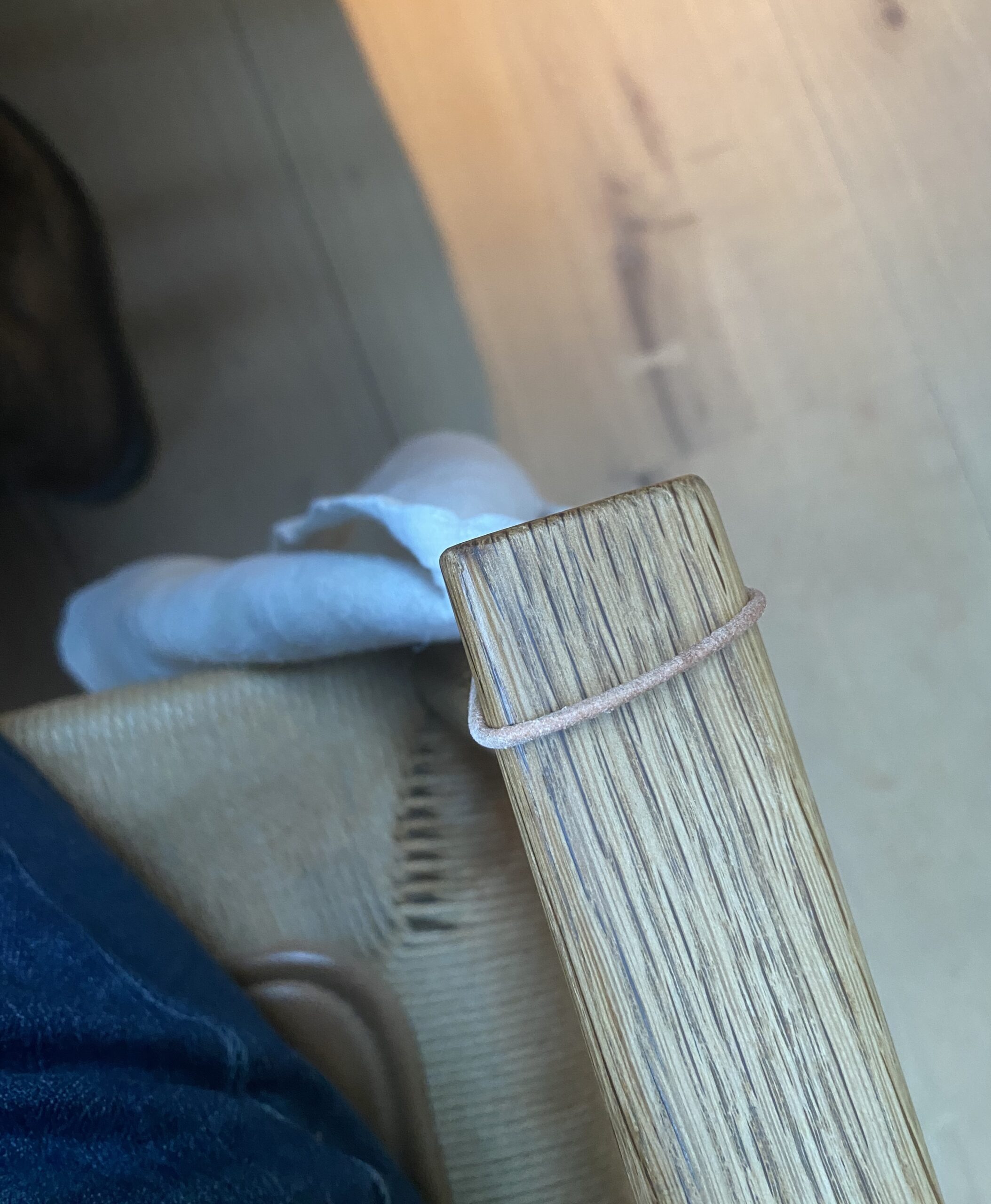
I sat down, and that’s when I noticed it. The napkin had a small piece of string on the back, and the staff — in the 90 seconds while I was gone — walked over, and hung the napkin on the side of my chair.

It was such a tiny detail. Who spends time thinking about where your napkin should go when you stand up? But the fact that they did think about it, and then figured out such an elegant solution? That they took the time to made sure to put care and attention into the absolute smallest elements? To me, that was almost as impressive as the Norwegian king crab.

(Though, don’t get me wrong: the Norwegian king crab was darn good, too.)

———

That’s the little hook on the back of the napkin. It was clearly something they’d made themselves — they took a linen napkin, sewed on a small piece of fabric to attach the hook to, and then inserted the string around it.