Do It For The Story.

take the leap

A buddy of mine from college got married last weekend. We went to Chicago to celebrate him and his new bride, and to toast good times. We told all of our favorite stories for the thousandth time, and we laughed until the wee hours.

And one phrase of ours from college kept coming up again and again:

“Do it for the story.”

Do it for the story was something we said when we needed a push to try something we knew was going to be hard.

Do it for the story was the motivation to be courageous, even when the odds were long.

Do it for the story was a reason to go for it, just because.

We were a pretty grounded group of guys back in college. 95 percent of the time, we did the reasonable thing.

But there was the 5 percent of us that was a little bit crazy, that was willing to try something maybe that shouldn’t be tried. It was the wild card in each of us, and you never knew when it might come out and make one of us try something unexpected. That 5 percent is the reason I ended up in China covering the Olympics, and the reason I ended up in Biloxi in 2012. It’s the 5 percent that — to quote the immortal words of “Risky Business” — made you say, “What the fuck.”

It’s good to be unreasonable. It’s good to push yourself to do crazy things. When you grow up, you learn that it’s so easy to get caught behind walls of your own design. Sometimes, you need to force yourself outside of your day-to-day and do something big, even if you’re not quite sure why you’re doing it in the first place.

So try something crazy. Do something you’re not supposed to do.

Do it for the story.

———

That photo of skydivers taking the leap comes via a Creative Commons license and Flickr user Laura Hadden.

What Happens After The Rocket Ship Levels Off?

The rocket ship levels off

I can’t believe I’m saying this, but: I completely agree with Simon Cowell on something.

You remember Simon, of course. He was the loud, controversial judge from “American Idol”, and the reason even I tuned in to see that show’s finales.[1. I still stand by my Ruben Studdard vote.]

Anyway, he said something in an interview with the New York Times last weekend that got me thinking about the way we define failure. He was asked about one of his other shows, “X Factor”, and he said:

“I read a book once about Coke and Pepsi and it was called ‘The Other Guy Blinked.’ And we blinked. We thought 12 million [viewers] was bad. Now, I’m thinking, ‘Christ, if I could launch a show with 12 million today, I’d be a hero.’ But we beat ourselves up so much about it and we changed so many things. The show became unrecognizable. I blame myself, but we made crazy decisions. We didn’t treat it like a hit. We treated it as a failure. I wasn’t aware the market had gone down to that level so quickly. I was in this La-La Land head space of 30 or 40 million and I thought 12 million feels terrible.”

That last sentence is the big one. What must it be like to launch a huge TV hit and still feel like a failure?

It makes sense if you think about where he’s coming from. Simon’s first U.S. hit, “American Idol” once drew 38 million viewers for a finale. But then the numbers dropped, and never fully recovered. Here’s what it looked like, according to Billboard:
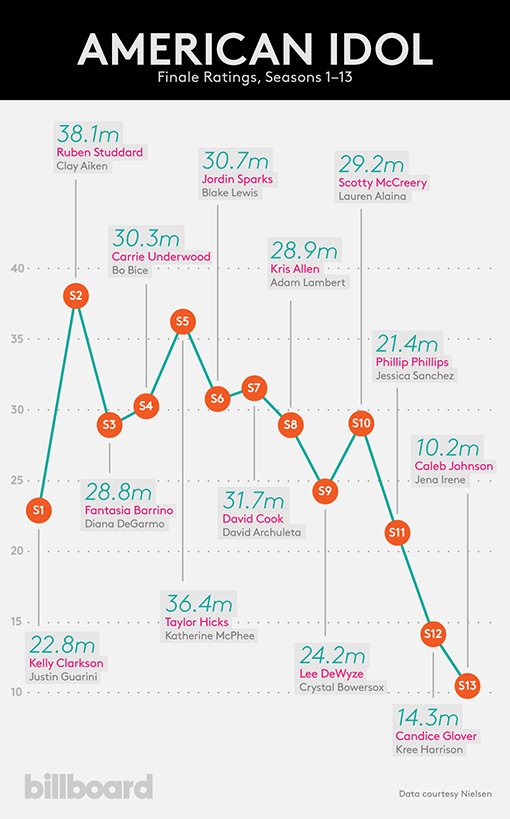
American Idol ratings by year

Even into it’s thirteenth season, the show was still drawing big numbers for finales. But it wasn’t what it had been a decade earlier.

Keep that chart in mind for a second. Now look at this:
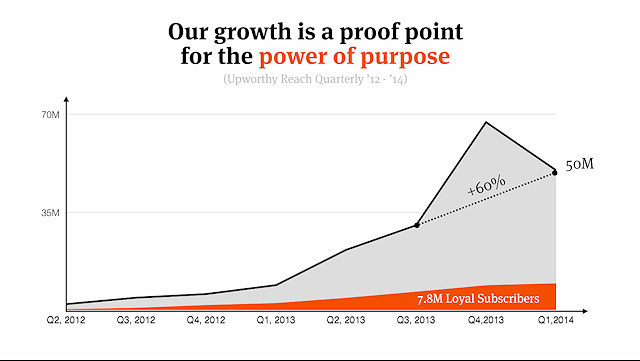
Upworthy before

That’s a chart that Upworthy, one of the fastest-growing publishers of the decade, showed off publicly in 2014 as they grew from zero to nearly 70 million unique visitors.[2. I’m going to pick on them for a second not because I dislike them — I actually think they’re doing really good work! — but because their last 4 years have been so well documented.]

Now let’s zoom out for a second:
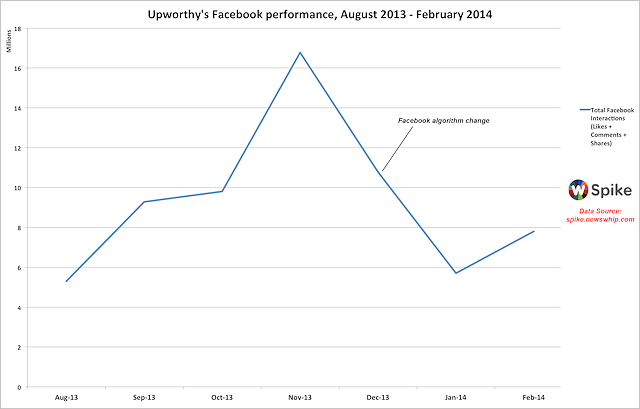
Upworthy after

That’s what it looks like when you rely entirely on another entity for success — in this case, Facebook — and then that business changes they way they do business. Facebook changed their algorithm, and Upworthy went from 70 million uniques to 50 million uniques, and kept dropping. Afraid that they could go from 70 million to nothing just as fast as they’d gone from 0 to 70, Upworthy changed their publishing strategy, and then changed it again. Now they’re doing what a lot of media companies — including BuzzFeed, where I work — are doing: Following the lead of distribution channels and hoping that the Facebooks and Snapchats of the world take us all to profitability. We’ll see how that strategy plays out over the next 3-5 years.

But what I’m most interested in is what happens to the people on the inside when a rocket ship like Upworthy starts to level off. That’s where Simon’s quote comes to mind. Read it again:

“We didn’t treat it like a hit. We treated it as a failure. I wasn’t aware the market had gone down to that level so quickly. I was in this La-La Land head space of 30 or 40 million and I thought 12 million feels terrible.”

“American Idol” was a rocket ship, too. It grew from nothing into a national phenomenon. But it didn’t last forever. The numbers dropped, and “Idol” merely became a big and hugely profitable TV show — merely a big and hugely profitable TV show! — not a supernova.

It’s all about perspective, though. What “Idol” built — and “X Factor” did, too — was a huge success, but from the inside, it clearly didn’t feel like that. And when you’re on a rocket ship like “Idol” or Upworthy, or the one I’m still on at BuzzFeed, it’s all about perspective. They’re about understanding that the ride up doesn’t last forever, that leveling off can be a normal course correction, that from where you stand — 12 million viewers, 50 million unique visitors, whatever — you’ve still built something impressive. You might feel like you’re losing ground because you’re not meeting your own expectations, and then you look around and realize where you actually are.

Maybe it’s not the up-up-up ride you thought, but you’ve still reached rarified air.

One last anecdote, from one of my favorite singer-songwriters, Todd Snider. I saw him tell a story once about Hootie and the Blowfish, a band he opened for back in the ‘90s. He talked about how their first album sold 16 million copies. Their second sold 3 million. Their third sold a million. They were a rocket ship that burned out. People called them a failure.

And it’s at this point in the story that Snider said, “Their third album still sold a MILLION copies! Sign me up for that kind of failure!”

It’s worth saying again: After “Idol” started to fail as a show, it still ended up running for 15 years. Simon Cowell launched two more hit shows. Upworthy is one of the biggest publishers in the world. Hootie sold several million albums. Darius Rucker went on to win a Grammy.

Yeah, sign me up for that kind of failure.

———

That photo of a rocket comes via SpaceX and Unsplash.

Is It Baggage Or Experience?

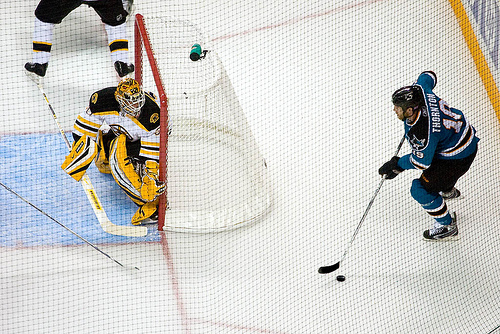
Joe Thornton

I’ve been thinking a lot lately about the narratives that we construct around our lives, and how they influence the way we see the world.

Point in case: The Stanley Cup Playoffs.

The San Jose Sharks are going to the Stanley Cup Finals for the first time in franchise history — after years of coming up just short. Wrote the San Jose Mercury News this week:

…their 5-2 victory over the St. Louis Blues in Game 6 of the Western Conference Finals came with an air of the surreal. This was Sisyphus getting the boulder up the hill. This was Wile E. Coyote catching The Road Runner.

Two guys on the Sharks — Joe Thornton and Patrick Marleau — had played a combined 2,767 games, but never made a Finals. And the narrative around them had always been about one thing: Baggage. Any discussion of their playoff success required talking about their many previous playoff failures. This was their fourth trip to the conference finals since ’04 — but they’d never been able to get over the hump.

Then this year, they did.

And suddenly, the narrative’s changed. For a player like Thornton, the media’s now talking about his 150 career playoff games as a sign of experience, not futility. Suddenly, he’s a veteran player who’s made it! The failures that came before were a test of his mettle, not proof that he couldn’t get it done in the clutch!

We’ve been through this before with so many great athletes. LeBron was the superstar who couldn’t win the big one, until he did. (Twice!) Phil Mickelson was the golfer who couldn’t win the big one, until he did. (He’s since won five majors!) The Red Sox couldn’t do it, until they did. (Twice!) The San Francisco Giants didn’t have what it took, until they did. (Three titles in five years!) Alex Ovechkin couldn’t win it all, until… OK, I guess I’m still waiting on that one.[1. ☹ ☹ ☹]

Point is: We’re all crafting these narratives, and every bit of work we put in is a chance to flip the script. You can always keep going, and always keep working to rewrite your story. It’s never too late — not even for a 19-year veteran like Joe Thornton — to breakthrough and change the narrative forever.

———

That photo of Joe Thornton was taken by Flickr user pointnshoot and used here thanks to a Creative Commons license.

Owning My Own Thing.

running, by Linh Nguyen

I am not old — but working at BuzzFeed sometimes makes me feel old.

Our staff is filled with so many awesome and truly talented young people. There are a lot of staffers in their early 20s. At 28 — almost 29 — I’m probably well above the median age at the company.

And the thing about working with so many young people is that every once in a while, you see someone truly kicking ass and realize: Oh, they’re five years younger than me.

Sometimes, a little bit of jealousy sets in. I’ll wonder: Why wasn’t I doing that when I was their age?

Whenever that happens, I have to remind myself of something I wrote four years ago about that exact phenomenon:

“I get jealous, sometimes, when I see 25 year olds who are way ahead of where I am. I get competitive. How’d that person pull off a book deal at 25? How’d they get a movie done? How’d they make their first million already?

But then I remember that this isn’t a 400-meter race. We’re not all shooting for the same end goal.

We’re all on different paths. We’re all running our own races at our own speeds.

It’s tough to tell where each of us is going now. It’s only with time — a decade, maybe more — that we’ll start to understand where we’ve been going.”

That last sentence really echoes with me now, this idea that it’s only with time that you understand where you’ve been going. If you’d asked me in September 2012 where I was headed, I wouldn’t have mentioned anything about BuzzFeed or newsletters. I thought I was on one path. Four years later, it’s clear I was headed somewhere different — and had no idea how fast I was getting there.

As for BuzzFeed in 2016: I get to work with so many awesome young people. I get to help them make great work, and they get to push me to make better things. We’re all on different paths, but at this very moment, we get to work with each other — and for that, I’m thankful.

And most importantly: I am doing my own thing, and I love it. I have to stop worrying about what everyone else is doing, and keep owning my own thing.

———

That absolutely awesome photo of someone running comes via photographer Linh Nguyen and Unsplash.

How Long Does It Take To Build A Great Reputation? Try 10 Years.

Mizzou football, 2007

An unusual and alarming thing has been happening lately, and I’m only now starting to figure out how to handle it:

College football is making me feel old.

It started about a year ago, when recruits coming to my alma mater, the University of Missouri, started saying things like, “I was a huge fan of Chase Daniel and Jeremy Maclin growing up,” or “Sean Weatherspoon was my favorite player when I was a kid.”

Those guys played at Mizzou when I was at school. Some of their teammates were in my classes.

If they’re the heroes that today’s 18-year-olds looked up to when they were in elementary school or middle school, that means….

Well, I must getting old.

But it also means another thing, something more about how long it takes a team or a business — or even someone like you or me — to build a reputation.

When I came to Mizzou in the fall of 2005, we weren’t particularly good at football. We’d beaten our biggest rival, Nebraska, just once in the previous 25 years. Mizzou was more famous for our losses than our wins.

But starting the fall of 2005, we started to win — and win a lot. Over the next decade, we’d win two Big 12 North titles, and two SEC East titles. We’d win three January bowl games. We’d have a Heisman trophy finalist. We’d reach no. 1 in the country.

And over the course of that decade, the conversation around Missouri football changed. When I entered as a freshman, nobody knew what “Mizzou” meant. My own grandmother often got confused and thought that I attended Washington University in St. Louis, and not the much larger, much-better-at-football school 120 miles west in Columbia, Mo. (When we hit no. 1 my junior year, she figured out which school I really went to.)

A decade later, I walk around New York in a Mizzou shirt and regularly hear people screaming “MIZ!” from across the road, the same way I see Michigan grads yelling “Go Blue!” when they see Wolverines gear. We even have a bar in the city, and we fill it every Saturday.

A photo posted by Mizzou NYC (@mizzounyc) on


It took a decade of success for Mizzou to switch the conversation. Why? Old timers in the state still think about Mizzou as the hapless team from the ‘90s and early ’00s that couldn’t win big games and could never beat Nebraska. But the younger generation — people like me, or the kids just entering Mizzou now — only know Missouri as a perennial football contender. In the decade we’ve been following Mizzou, we’ve only ever seen success. So why should we expect anything different?

It took an entire generation of success — a full decade of winning — to change the conversation.

And that’s gotten me thinking about the idea of a decade of great work. My first big journalism breakthrough came in the summer of 2008, when I covered the Olympics for the Rocky Mountain News. Which means that I’m two years away from that 10-year mark. In that decade, I think I’ve had enough highs (Stry.us, the RJI fellowship, BuzzFeed, speeches at several conferences) to have built a reputation in the industry. I’m not all the way there yet, but eight years in, I’ve established myself through my work.

Here’s to changing the conversation — and finishing off that decade strong.

———

That photo of Mizzou football in 2007 comes via Flickr, a Creative Commons license, and Jim Ross for EAGLE 102 Sports.

Setting A Reach Goal.

Goal

It’s January, and you’re two weeks into your New Year’s resolution, so let’s talk about goals for a second.

I love New Year’s resolutions. I think they’re a wonderful way to set ambitious goals for the year ahead. And if they’re matched with a change in habits, they can actually lead to some incredible changes in your life.

But most of all, I love when someone sets a New Year’s resolution that’s also a “reach goal.”

What’s a reach goal? It’s any type of goal that can’t be achieved without extraordinary effort. It’s a goal that you set knowing that you may try your hardest — and still come up short.

The difference between an ordinary goal and a reach goal is huge. An ordinary goal might be to say, “I want to write more this year.” But with a reach goal, you’d pledge something bigger: “I want to write 1,000 words a day this year!” The goal is both concrete and ambitious. With a reach goal, you set the bar well beyond your ordinary limits — and then find out how far you can actually go.

Sally and I set a few goals for ourselves this year. We want to bring our lunch to work more often, and we want to dedicate 30 minutes every Sunday to clean the house. Those are goals we can definitely achieve.

But we also set a reach goal for ourselves: Together, we want to run 1,000 combined miles this year.

I like running. But I’ve never run 500 miles in a year. I’m the kind of runner who might run 20 minutes on the treadmill every week, or run a 5k every now and again. In my best year, maybe I’ve run 250 miles. So to run 500 miles, I’m going to have to log some serious miles every single week.

It’s going to be a lot. I don’t know if I’m going to get there. But that’s besides the point: I’ve decided to push myself to do something that I don’t know if I can do, and I’m excited to see how far and how hard I can go.

———

That photo of an actual goal comes via Flickr user Al King and Creative Commons.

Opportunities vs. Possibilities.

photo-1449182325215-d517de72c42d

These are two words that people often use interchangeably:

One is “opportunities.”

One is “possibilities.”

As you get older, you learn that there’s a big difference between the two.

Opportunities are the concrete choices you have to make. They come in the form of job offers or acceptance letters from a school. There’s nothing theoretical about them. When you’re presented with an opportunity, you have to make a choice.

Possibilities, on the other hand, are just dreams. Could I move to Bolivia one day and become a goat farmer? Could I quit my job, move to Thailand, and teach ex-pats how to surf? Could I become president of a big company? Sure, anything is possible!

To put it another way: Opportunities are the things that can happen, and possibilities are the things that could happen.

But here’s where it gets important: When you’re young, it’s all possibility. You’ve got dreams and ambition, but not a lot of hard choices that need to be made. As you get older, the scale starts to shift. You’re no longer thinking about what could happen because you have choices that you actually have to make. You’re setting down, you’re starting a family, and you’re thinking about the opportunities that actually exist for you at this moment.

If you’re lucky, when you’re young, you can turn a dream into real work. You’re not tied down by anything — a job, a significant other, a family, a mortgage. That freedom gives you the ability to try something crazy. That’s what Stry.us was for me — a crazy dream that I actually made happen. But as you get older, the windows of possibility start to close. You still try to stay ambitious and idealistic, but you also start to become more practical. You start to make hard choices because you have to, not because you want to.

There’s a difference between “What will you do?” and “What can you do?” So when you’re young, and everything’s still on the table, take advantage of it. Those doors might not stay open for long.

———

That photo of the open road was taken by Jon Ottosson, and published on Unsplash.

Another Word About Failure.

98174687_9a5daf5c11

Three years ago, I wrote a thing about failure. Much to my surprise, it still holds up pretty well! I wrote:

There is a phrase I use a lot. I overuse it. A lot of my friends do, too.

The word is “fail.” ….

But sometimes, when we just wrap all that in into that one word — fail — we lose a sense of what we’re really trying to say. …

So if I’ve told you, “It’s okay to fail” or “Go fail fast,” I’m sorry. I can say it better.

This year, be willing to do difficult things. Be willing to go on adventures where you don’t know the outcome. Be willing to persevere.

Most of all: Be willing to do great work.

The idea of “failing fast and failing often” has spread even further since I wrote about it back in 2012. And looking back on that first post, I realized: I never got around to defining what failure is!

Here’s the thing: Anyone who tells you they like to “fail fast and fail often” has probably not truly failed in their life. Maybe they’ve goofed up on a project. Maybe they fucked up an assignment.

That isn’t failure.

When you take on work that really matters to you, and you truly fail, you feel like absolute shit. Failure gnaws at you. It keeps you up at night. It makes you question every decision you’ve made along the way.

When you fail while doing something meaningful, it sucks the life out of you. And that kind of failure takes weeks or months — or even years! — out of you.

The people who advocate “failing fast and failing often” are people who really mean to say: It’s OK to screw up! It’s OK to suck at your work! And they’re not wrong — it is OK to make little mistakes along the way.

But that’s not failure. Failure is the roadblock that keeps you from going one step further with your work. Failure sends you onto a detour from which you don’t completely return. And in the long run, that’s also OK — failure is something that can shift you onto a completely different track, and maybe that’s a path where you can do great work and succeed.

Anyone can screw up. But to fail, deal with that failure, and somehow pick yourself back up and start again? That’s a different thing altogether.

———

That photo at top comes via Flickr user Sister72.

Shit Happens.

The work never goes like you want it to.

Oh, you had big plans? Shit happens.

Oh, you had goals/ambitions/dreams? Shit happens.

Oh, things were supposed to go a certain way? Yeah… shit happens.

I’m not saying you shouldn’t make plans — you should! It’s good to anticipate problems, and to try to get ahead of the work. But the work always gets weird along the way. You learn that something can’t work a certain way, or should actually work a completely different way. Your team takes a hit. Something breaks.

Things always go wrong. It’s just the way it goes.

So are you willing to push through it? Are you willing to keep working, even when things suck?

The best don’t use those bad breaks as an excuse. They find a way to get the work done anyway.

Good luck. Keep doing the work.

The Hard Thing Is That There Are Always More Hard Things.

photo-1444090695923-48e08781a76a

It’s fall, which means I’m already thinking about plans for 2016. The new year is less than 90 days away, and there are a ton of big decisions to make between now and then.

As I think about the state of my four-person team at BuzzFeed, these challenges come to mind for 2016:

-We need to grow our team.

-We need to find a way to train new team members in the way we work — how to launch stuff quickly, mess around with new ideas, and use data to make informed decisions.

-We need to maintain the industrious spirit of a small team while growing into a (slightly) bigger one.

-We need to continue to grow our subscriber base.

-We need to launch new products.

-Some of those products will be launched in other countries.

-And some of them will be launched in languages other than English.

That’s a lot — and the secret is, it’s just the stuff that’s in front of me right now. In three months, we’ll have almost certainly knocked a few things off that list… but a new challenge or two will be added to it. Maybe we’ll add our first team member in a different city. Maybe we’ll be forced to make unexpected cuts to our lineup of newsletter products. Maybe we’ll have challenges implementing new types of advertising into our newsletters, or struggle to communicate with other teams here at the company.

Something new will come up. It always does.

And that’s the truly hard thing about working in a startup like BuzzFeed, I’ve found: There are always new challenges to face. Once you’ve mastered one challenge, another one presents itself. Sometimes, old challenges show up again in new ways!

The hard thing is that there are always more hard things to take on, and you have to be mentally prepared to taken on challenge after challenge. It’s why it’s so important to have those moments during the day to think, and it’s why it’s doubly important to have a great team behind you. The challenges will always keep coming. Make sure you have the time to center yourself, and make sure you have the team to take on what’s next.

———

Yes, that’s an incredibly obvious “mountains beyond mountains” metaphor of a photo at top. It’s from Unsplash and photographer Nitish Meena.