
So What Do You Want To Ask?

unsplash_52cee67a5c618_1

I’ve been lucky to meet some exceptional people in my life, and there’s something interesting that I’ve noticed about almost all of them. They have a lot of the common traits you’d expect — they work hard; they surround themselves with good people; they’re highly skilled; you get the idea. But there’s something else:

Almost every one I’ve met has asked excellent questions.

I think anyone can come up with an answer to life’s weirdest questions. But it takes a different kind of person to ask a good question. To ask a good question, you have to be curious, and you have to be genuinely invested in asking that question. (Anyone can tell when they’re being asked a question by someone who doesn’t really care about the answer.) I find that people who ask good questions tend to be detail-oriented.

To put it simply: A person who asks great questions is someone who actually wants to understand how and why the world works, instead of just taking it all at face value.

And I don’t just see it in the journalism world! Open up a biography about Warren Buffett or Sam Walton and you’ll find countless stories of men who were constantly asking questions, always probing beyond the surface for answers. (Walton’s biography, in particular, is full of stories about him going to Wal-Marts with his tape recorder in hand, spending hours asking his employees questions about the way they really worked.) Doctors, artists, bankers, coaches — I’ve met all sorts who know how to dig for answers.

I think it’s everyone could get better at — myself included! I think we’d find that there’s a lot more to learn about the people in our lives, if only we’d learn to ask.

Want to get better at asking questions? I’d recommend this quick guide to asking questions by a former investigative reporter.

———

That photo of someone searching for something — higher meaning, or probably just a bird in the woods — comes via Unsplash and photographer Caleb George.

10 Things That Will Save You So Much Trouble At The Office.

photo-1416339442236-8ceb164046f8

1.) Don’t send emails if you don’t have to. If you can walk over to someone’s desk and explain something, do it. If you can make a phone call, do it. Unless it’s something simple, don’t send that email. It’ll save you time in the long run.

2.) Say “Congrats!” If someone kicks ass on a project, send them a quick note. It can be three sentences. It can just be a link to their project with the words “Nice job!” in the subject line. Even a small gesture makes an impression.

3.) Be direct. Don’t sugarcoat things. Don’t bury bad news. Just be straightforward with people, especially around bad news.

4.) Set limits for work. I don’t respond to emails between 7 p.m. and 7 a.m. I set that expectation early on in my job. There are often nights I’m up working past then, but unless something’s on fire, I won’t respond until the morning. It’s all about setting your personal boundaries. Own your work — and don’t let your work own you.

5.) Be prompt. I try to respond to all texts and all emails within 24 hours. Think about how you feel when someone responds to one of your emails a week late. You don’t feel valued, right? Always try to respond promptly (not immediately, just promptly).

6.) Say “I’m sorry.” Take responsibility for your actions, and sometimes, take responsibility even when it’s not your fault. Nobody wins when you pick a fight.

7.) Be nice! Hellos and remembering names go a surprisingly long way.

8.) Don’t be a jerk! It is shockingly easy to be one — especially in an email or over Gchat. At any office, you don’t have to be liked to get stuff done — but you do have to be respected, and nobody respects the jerks in their office.

9.) Remember these rules for email: Don’t reply all to inter-office threads. Use Gmail’s Mute button liberally. And don’t be afraid to use smiley faces and exclamation points — they’re really good at communicating tone.

10.) Be someone who delivers on promises. I always seek out the people I know will deliver their work on time. There aren’t enough hours in the week to wait for other people to get their crap together. Work with people who get shit done — and be one of those people yourself.

———

That photo of a workspace comes via via Unsplash and photographer Jeff Sheldon.

The Worst Piece Of Advice You Can Give.

Here’s a piece of advice you’ve certainly heard before: Not where you want to be? That’s OK.

Just fake it ‘till you make it.

I really hate those words. I think it’s a very dangerous piece of advice — especially for young people who are still trying to find their way.

And here’s what I want to say instead:

Don’t pretend to be someone you aren’t. When you’re young, there are days when you feel like you know everything — but far more when you’re convinced you know absolutely nothing. And on those days, it’s easy to pretend to be the expert you aren’t just yet. Some people make a short-term (and shortsighted) choice to fake it.

But there’s never a need to fake your expertise. Never.

So don’t fake anything. And anytime you feel like you’re becoming a person you aren’t, here’s all you need to remember:

Be confident in who you are and what you know. You probably know more than you give yourself credit for!

Be honest with people about who you really are.

And when someone asks you for something and you don’t have the answer, it’s OK to say, “I don’t know.”

But there’s a catch: The minute you say it, you have to start working towards actually finding the answer. That means realizing that you’re smart enough to build the support system around you to get the right answers, and understanding that you’re going to have to work hard to keep learning.

That’s the harder way — but it’s also the one that’s going to earn you trust and pay dividends in the long run.

Staying Ahead Of The Line.

swimmer

Here’s another hard truth about doing the work: It’s largely about setting goals and accomplishing goals. And accomplishing goals is really freaking hard.

The work usually goes like this:

1. You set your goals.
2. You start accomplishing some of your goals.
3. You feel great about how much you’ve accomplished already.
4. You feel like you’re accomplishing so much so fast!
5. You look at the calendar and realize that it’s almost the end of the year and you’ve still got a million things left to do.
6. You flail wildly and struggle to the end of the year.

And this is in a good year.

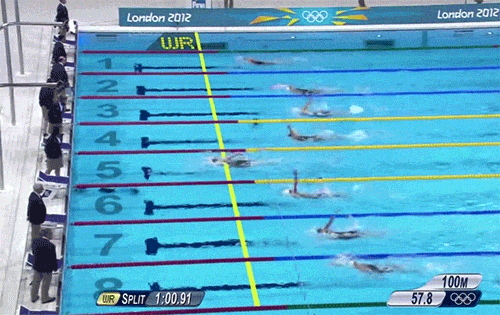
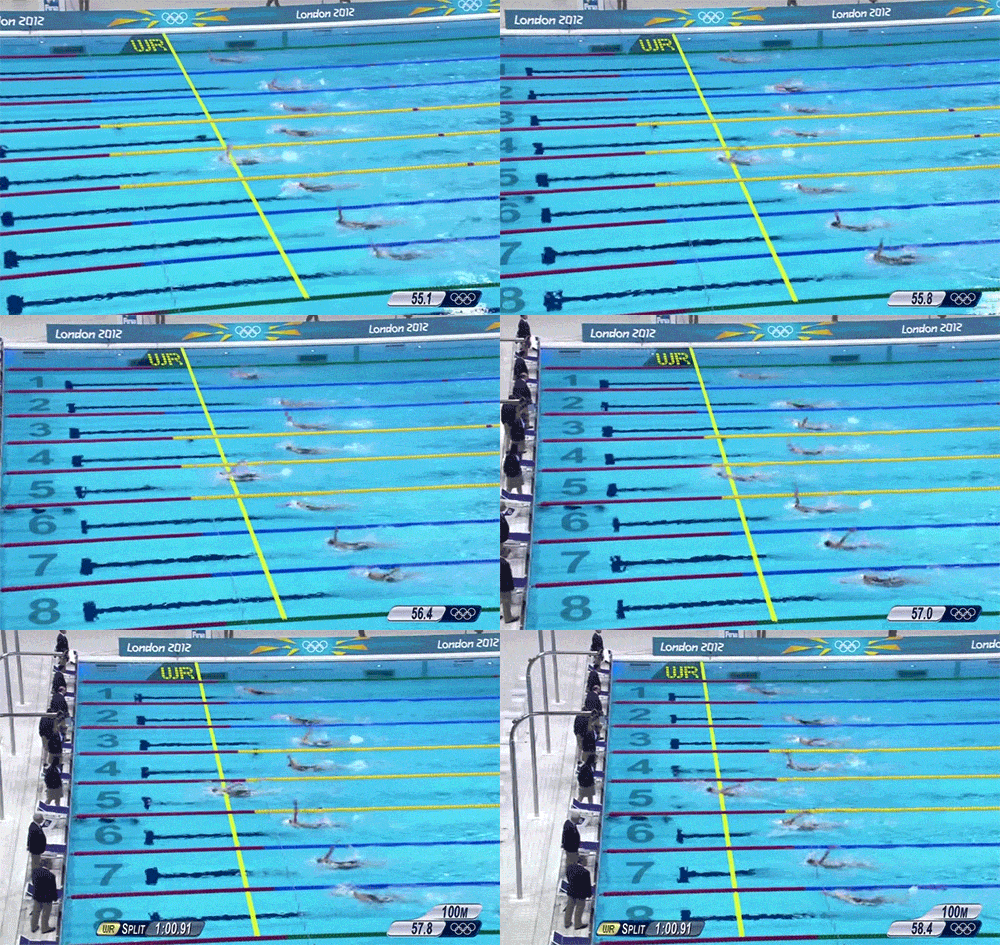
As soon as you set your goals, you basically become Missy Franklin, the swimmer in this GIF:

ahead-of-the-line

The yellow line represents the world record pace. In order to beat it, she has to stay ahead of that line. And no matter how fast she goes, she can’t seem to get ahead of the yellow line.

This is the nasty secret: You won’t ever really get ahead of the yellow line. You rarely get to feel like you’re way ahead your goals, because — and this is really, insanely annoying — as soon as you do beat your goals, you’re going to set new, more outrageous goals. And then you’ll flail again in hopes of catching up to those.

You set the bar, hit that new height, and reset everything. But you never really get ahead.

Mentally, it’s a massive adjustment — there are no true end goals, just carrots that you’re forever chasing down the road. But over time, you learn to adjust. You learn to celebrate your smaller victories, and to cherish the really big accomplishments.

And then you go and chase the next big goal. That’s just how it is.

That GIF of Missy Franklin breaking the world record in the backstroke at the 2012 London Games comes via this YouTube video.

Just Do The Best You Can Do.

4040634967_0927cbbeb9_z

Three years ago, I wrote a post about Todd Snider, a singer/songwriter I really love. Whenever I’ve gone through strange times, I’ve always had Todd to remind me that things can — and almost certainly will — get even weirder along the way.

This line especially stands out for me, re-reading that post now:

I know haven’t gotten that far in the entrepreneurial process. No, I don’t know what lies ahead.

But I suspect that when I get there, I’ll find there’s a Todd Snider song that explains it perfectly.

And, of course, three years later, there is.

It’s from a song called “Money, Compliments, Publicity,” and I’ve been thinking about it a lot lately. I don’t always know what the right next decision is for me, and sometimes, I’ve wondered if there’s a magic piece of advice that could just unlock everything.

Todd’s obviously wondered that, too. And so he sings:

I went to see this therapist
She said, “Just do the best you can do
Do the best you can do”
I was hoping for something more specific

I love that. Most of the time, there isn’t a phrase or a single piece of advice that’s going to solve everything. You just have to listen closely, think wisely, and make the best choices you can.

And then move on.

Thanks for the reminder, Todd.

That photo of Todd comes via Flickr’s kubacheck.

A Brief Explanation Of Why I Went To Fargo This Weekend.

Don’t get me wrong: I love working in journalism in New York. But the New York media world is pretty small. Go to events or conferences, and you see a lot of the same people. (And I’ve discovered that the world of New York people who do email stuff — my expertise at BuzzFeed — is even smaller.)

So once a year, I try to go to something that’s totally outside my little worlds.

In 2012, it meant a TEDx event in D.C. Last year, I went to Portland for a conference called the World Domination Summit.

And this year, I went to Fargo for MisfitCon — an impressive little conference for people who make stuff (both online and IRL).

I met all sorts of people this weekend in Fargo: actors, accountants, painters, writers… you get the idea. They’re people I don’t get to talk to that much. Which meant that I got to hear about stuff I don’t ever get to hear about — and now I’m coming back to New York with some good new ideas and energy.

I’m not saying you have to travel all the way to North Dakota to escape. But every few months, it’s worth getting outside your normal circles. You’d be surprised at what you might learn.

I took that photo at MisfitCon.

You Know More Than You Know.

A few years ago, I came to a strange point with Stry.us. I had been working on the project for a while, and the initial giddiness of working on something new had worn off. Suddenly, I felt overwhelmed with it all. There was so much I didn’t know, and it felt to me like I was the only one who didn’t know what he was really talking about.

I didn’t quite know how to explain it back then, but I can now. (Funny how much a few years of perspective helps.) What I was experiencing was twofold:

1) I was challenging myself, and realizing that to succeed in my new role, I was going to have to learn a lot.

2) I was struggling to remember that even though I had a lot to learn, I also still knew a lot.

That didn’t make sense to me when I first went through it. I honestly believed that I couldn’t be smart AND have lots to learn at the same time. I thought it was either one or the other.

But the more people I talk to about my experience, the more I realize that I wasn’t alone in this. A lot of people struggle with that mentality when they take on a big new role.

So when you find yourself in that situation — when you feel overwhelmed with what you still have to learn — these two things can help:

1) Be honest with others about what you know. When you know the answer, speak up! Chances are, you know a lot more about your work than you’d give yourself credit for.

2) Be willing to say, “I don’t know.” It’s not a sign of weakness. It’s not a sign of failure. When you say those words, you’re making a promise to yourself to go out and find the answers. And often, you’re making a promise to get help from others.

You can be stubborn, and pretend to know it all, or you can grow as you go. I’d take the second path if I were you.

Data + Story.

kiyomi and taro shibas, on the couch

Two weeks ago, while I was writing out my annual “What I Believe” post, I had a small epiphany, and jotted this down:

If you can show it in a spreadsheet, you can sell it. And if you can pair that data with a great story, you’ve really got something.

In my job at BuzzFeed, I report to two people: Dao, our director of traffic; and Erica, our managing editor. With Dao, it’s all about numbers. Show her that the numbers are trending upward, and she’ll listen.

With Erica — and any of the other editors at BuzzFeed — it’s all about the story. If you can tell a great story, they’ll listen.

When you pair those together, that’s when the magic really happens. I wrote that when you put them together, “you’ve really got something.” Which is true.

But what I really meant to say is: When you pair them together, you’ve really earned respect. In your work, you’ll have to sell your ideas to others. One of the secrets to sales is being able to pair data and a great story. Get those two elements together, and they’ll not only listen — they’ll follow you where you want to go.

That’s a photo of two shibas, because, you know, BuzzFeed. It comes via Taro the Shiba Inu on Flickr.

What Can Happen When You Put Things Out There.

So here’s what I love about that story, above, from the very talented Kishi Bashi:

Sometimes, you stumble into amazing things. Sometimes, you make a snippet of a thing, and people like it, and they ask for more. Sometimes, you unintentionally put something amazing into the universe.

Our world is full of happy accidents, of the times that you stumble onto something great. But the only way to get there is to put something out into the world first.

Go. Make. Share. It’s the only way to really know.

Being Normal Seems Weird.

“I don’t do normal. I have a reputation to uphold.” ― Joan Bauer

 
I’ve had a lot of conversations lately about the idea of normal. They usually start with a statement like this: “Dan, there’s nothing even remotely normal about you.”

To which I usually say: Why, yes, thank you.

And then: Do I really want to be normal?

If someone describes me, I’d hope they use a better word. Like remarkable. Or ambitious. Or even crazy.

I’d want to hear that I’m doing something with my life that’s making an impression, and that I’m doing it in a way that stands out.

Normal? That just doesn’t sound right to me at all.